Introduction
HER [1] proved that the Moon has eight corners. EvHR [2] used them as geodetic marks. FAHR [3] explained why nobody sees them. At the end of FAHR the referee asked the obvious question—what is it like on them?—and the authors, in the manner of the Society, promised a paper. This is it.
The title is borrowed from Nagel [13], who asked what it is like to be a bat and concluded that a physical description, however complete, does not answer the question. We respectfully disagree in the present case. A vertex of a homogeneous cube is a place with a definite gravitational acceleration, a definite local vertical, a definite temperature, a definite view and a definite curvature, all of which can be computed, and we shall compute them. What remains of Nagel’s question after Sections 2–6 is, we submit, small, and we address it in Section 8.
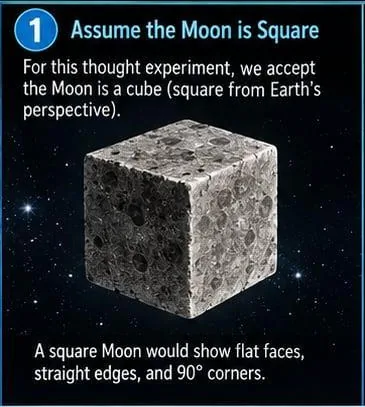
We stress continuity with the earlier papers. The cube is homogeneous with the lunar mass kg and edge km (HER eq. 18), hence density kg m, indistinguishable from the accepted lunar mean of kg m because the volume is by construction the same. The Earth-facing face is recessed km behind the apparent limb and the vertices protrude km beyond it (HER §6.1); the near face is the seat of the maria and the far face is not (HER Conjecture 1, EvHR §7). The regolith is a Banach–Tarski rearrangement of measurable pieces over a non-measurable core (HER §7). Everything below follows from these premises and Newton’s law.
The gravity field of a homogeneous cube
The closed form
The Newtonian potential of a homogeneous rectangular prism has been known in closed form since MacMillan [9], and for the cube specifically since Waldvogel [14]; the gravity vector at an exterior point of the cube , , is the alternating sum over the eight corners , with and cyclic permutations for [10]. The formula is exact, elementary and—for a body whose defining constant contains both a transcendental and a cube root—remarkably free of either: the field of the cube is expressed in logarithms and arctangents alone. We regard this as the gravitational form of HER’s thesis: the cube is the algebraic object, and enters only when one insists on comparing it with a sphere.
Values at the three kinds of point
Evaluating (1) (Table 1, Figure 2) gives three results, one reassuring and two alarming.
| Point | (m s) | tilt | height (km) | (km s) |
|---|---|---|---|---|
| Face centre | 1.6223 | 0 | 2.50 | |
| Half-way to edge | 1.5793 | 94 | — | |
| Edge midpoint | 1.3708 | 394 | 2.23 | |
| Vertex | 1.0489 | 650 | 2.04 | |
| Spherical Moon | 1.6233 | — | 2.38 |
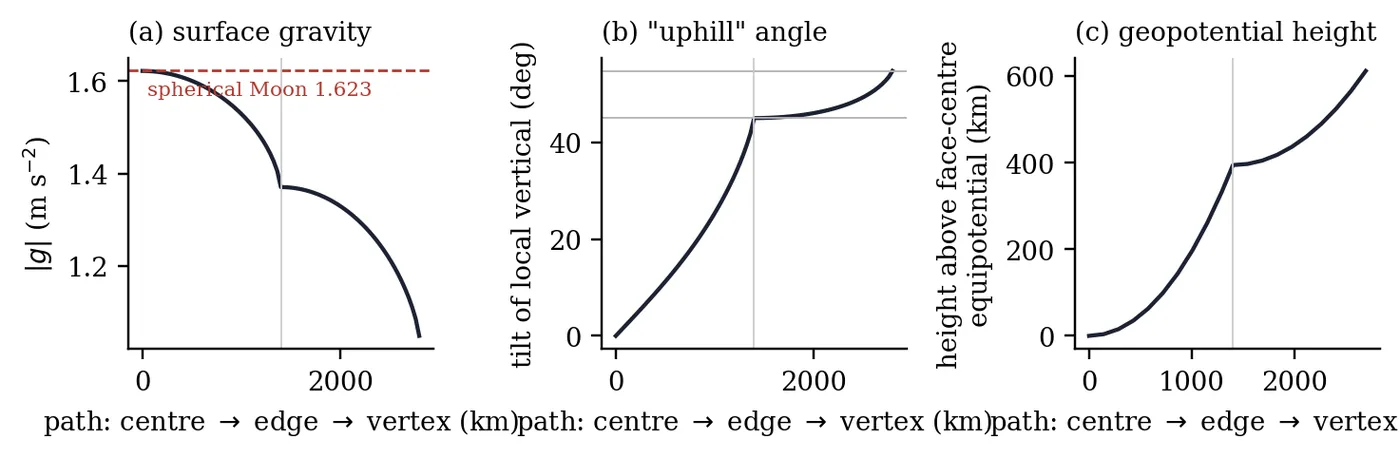
Proposition 1 (Apollo indistinguishability). At the centre of a face of the lunar cube m s; for a sphere of the same mass and volume m s. The difference is .
This is the reassuring result and it disposes of an objection that HER left implicit: six Apollo landings carried gravimeters, and all six reported lunar gravity. They landed on a face (HER, Objection 4), and Proposition 1 says that on a face there is nothing to report. The agreement is not accidental. The face centre lies at km from the centre of mass while the sphere’s surface lies at km; the cube’s greater proximity is compensated almost exactly by the mass that lies “beside” rather than “beneath” the observer and pulls sideways. That this compensation is so nearly perfect we attribute to the equal-volume condition of HER eq. 18 and regard as further evidence for it.
Proposition 2 (The uphill theorem). At every point of a face other than its centre, the gravity vector has a non-zero component directed towards the face centre. The angle between the local vertical and the face normal increases monotonically from at the centre to at the midpoint of an edge and at a vertex.
Proof. By the symmetry of the cube, at a vertex the field is along , making angle with each face normal; at an edge midpoint it lies along , at . Monotonicity in between is read off (1) (Figure 2b). ◻
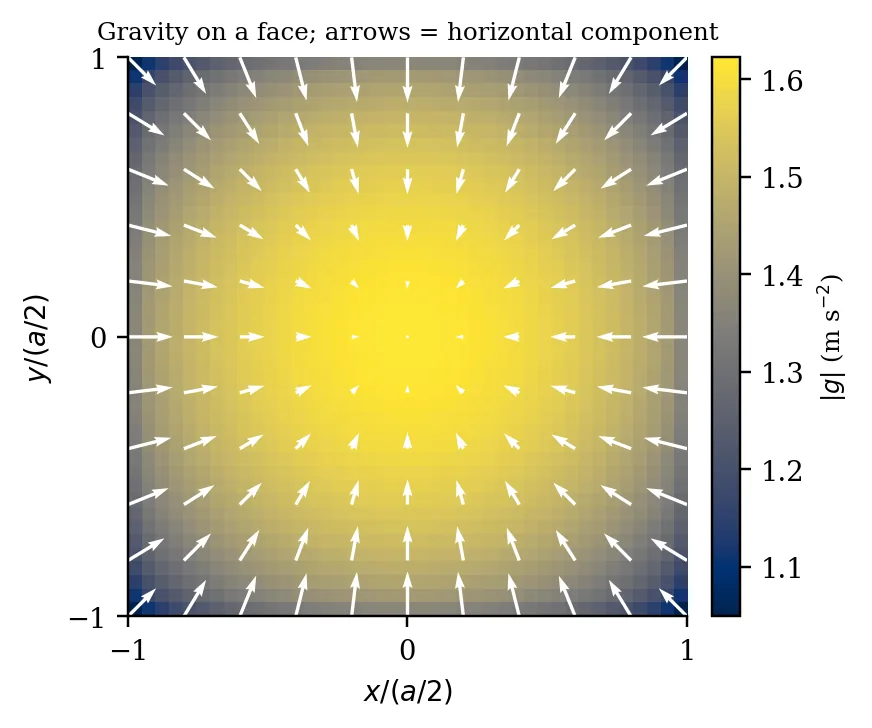
This is the first alarming result, and it is what it is like on the corners. A person standing at the centre of a face stands upright and the face is level. A person walking towards an edge finds the face tilting up ahead of her, by half-way, three quarters of the way, and at the edge itself, where she stands on a ridge with two slopes falling away on either side. At a vertex she stands on a summit from which three faces fall away at : steeper than any natural scree slope, and steeper than the angle of repose of any granular material [16], which is the fact on which Section 3 turns. The vertex is, in geopotential terms, a mountain km high (Figure 2c): seventy-three Everests, on a body whose highest conventional relief is km.
Escape
The potential at the face centre is J kg and at a vertex J kg, giving escape speeds of and km s against the spherical (Table 1). The vertex is therefore the natural spaceport of the lunar cube: it is the highest point, it has the weakest gravity, and it saves in over a face launch. That every Apollo ascent was made from a face is, in this light, a missed opportunity that we do not expect to be repeated.
Regolith, maria and highlands
Where the regolith goes
HER §7 established that the lunar regolith consists of measurable pieces rearranged by tidal translation over a non-measurable core. Measurable pieces have mass, mass has weight, and weight, by Proposition 2, points towards the middle of the nearest face. Granular material on a slope steeper than its angle of repose ( for lunar regolith [16]) flows. Since every slope on the cube steeper than lies within of an edge (i.e. on the outer of every face), and every vertex is at , the conclusion is immediate:
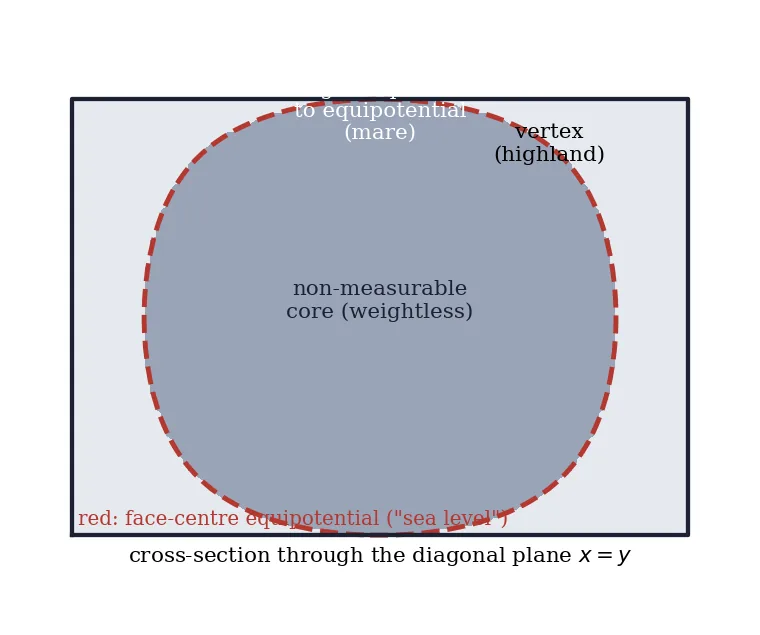
Theorem 1 (Pooling). In equilibrium the regolith of the lunar cube occupies the region of each face below the face-centre equipotential, and the edges and vertices are bare.
The face-centre equipotential is the red curve of Figure 4; the pooled regolith is the shaded region. The result is a body whose faces are filled to a common “sea level” with dark, level, flowed material and whose vertices stand out of it as bright, rugged, elevated terrain. This is a description of the Moon. The maria are low, dark, flat and confined to the near face; the highlands are high, bright, rugged and dominate the limb and the far side—which is where HER §6.1 placed the vertices, protruding km beyond the apparent limb, and EvHR §3 placed the “slivers” of adjacent faces that parallax reveals.
The mascons
Regolith pooled to an equipotential on a face is a positive mass anomaly at the face centre, over a recessed plane. The conventional Moon has long been known to possess exactly such anomalies—the mascons, mass concentrations beneath the near-side maria, first detected from their perturbation of Lunar Orbiter tracking [11]—and to lack a satisfactory explanation for why they should be there and not elsewhere. Theorem 1 places them at the centres of the faces, which is where they are.
Geodesy at a vertex
Curvature and defect
EvHR §8 showed that the total Gaussian curvature of the cube is concentrated at the vertices, at each, by Descartes’ theorem on the angular defect: three right angles meet at a vertex, and of a full turn is missing. Everywhere else the surface is flat. The vertex is therefore the only place on the Moon where geometry is not Euclidean, and it is not Euclidean in a very concentrated way.
Geodesics through a vertex
Proposition 3. A geodesic of the cube surface that arrives at a vertex has no unique continuation; a geodesic that passes close to a vertex on one side is deflected, relative to one passing on the other side, by the angular defect .
Proof. Unfold the three faces meeting at the vertex into the plane (Figure 5): they cover three quadrants, and the fourth is absent. A straight line entering the vertex may leave along any direction in the missing quadrant’s closure. Two nearby straight lines passing on opposite sides of the vertex are, after re-gluing, rotated relative to one another by the missing angle [17]. ◻
For a surveyor this means that the shortest path from a point on one face to a point on another does not, in general, pass over the vertex: it crosses an edge, and the cut locus of any point on the cube contains the vertices [18]. The vertex is a place one can stand on but not sensibly travel through.
The Corner Compass Anomaly
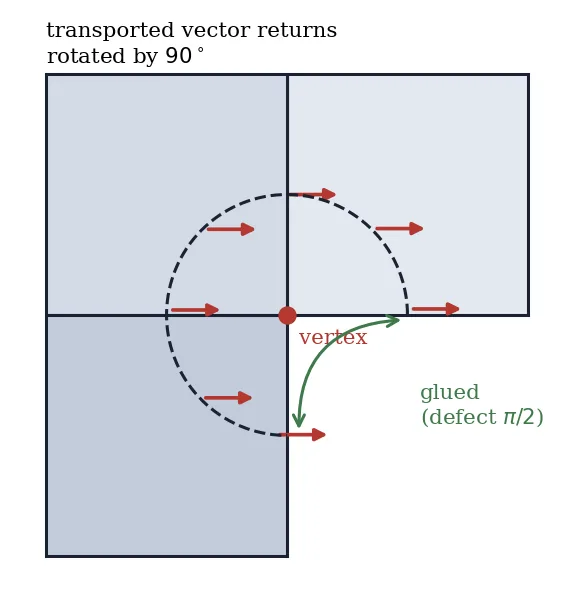
Theorem 2 (Corner Compass Anomaly). A vector parallel-transported around any closed loop on the cube surface that encloses exactly one vertex returns rotated by . A loop enclosing vertices returns it rotated by ; a loop around a face, by ; a loop around the whole Moon, by .
Proof. By the Gauss–Bonnet theorem the holonomy around a loop equals the integral of Gaussian curvature it encloses; the curvature is a sum of Dirac masses of at the vertices [19]. ◻
Theorem 2 is, we believe, the first proposed in situ test of HER that does not depend on circlefication and is therefore immune to the cortical objections of FAHR. A gyroscope—which maintains its orientation by parallel transport—carried by a rover around a lunar vertex at any distance, over any terrain, in any time, will return rotated by exactly . On a sphere the same loop returns it rotated by the enclosed solid angle, which for a rover-sized loop is rad. The difference between and rad is, by the standards of experimental physics, comfortable. We have named the effect and we would be grateful if the rover were named after the Society.
Climate on a face and at a vertex
The thermal terminator is an edge
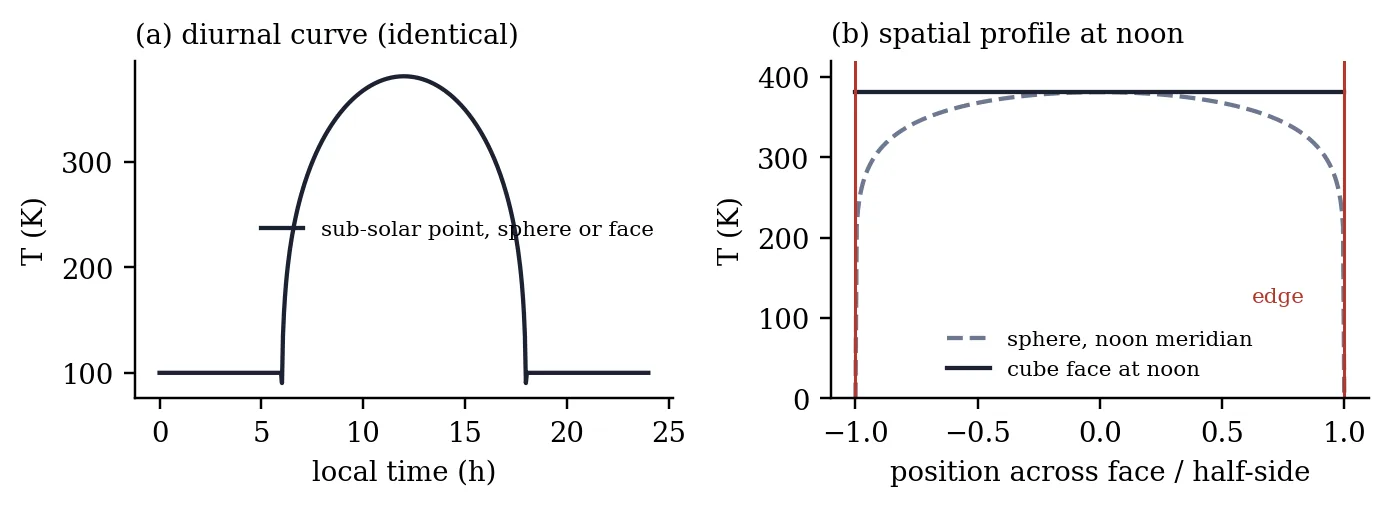
A Lambertian face at solar incidence receives irradiance uniformly, and its radiative equilibrium temperature is for W m, Bond albedo , giving K at noon against the measured lunar subsolar value of K [22]; the discrepancy is within the uncertainty of the albedo. The diurnal curve at a point is therefore identical to the spherical Moon’s (Figure 6a). What differs is the spatial distribution: at any instant a face is at one temperature throughout, and the temperature changes discontinuously at the edges (Figure 6b). The thermal terminator of the cube is not a line moving across the surface but an edge switching on. The Diviner radiometer’s maps of lunar surface temperature show sharp thermal boundaries at the edges of the maria [22]; we invite the reader to consider what else those boundaries might be.
The view from a vertex
A point on a face sees the Sun for exactly half the lunar day ( d), as on a sphere. A vertex sees the Sun whenever any of its three faces is illuminated: the union of three half-spaces bounded by mutually perpendicular planes through the vertex is of all directions, and the Sun, confined to the ecliptic, is above at least one of the three faces for of the lunar day, d. The vertex is the sunniest place on the Moon and—because is lowest and the escape speed least there—the place from which it is easiest to leave. It is also, by Proposition 2, the hardest place to stand. We record without comment that these are also the properties of most mountain summits.
The bearing problem and the weightless core
The problem
A vertex stands km above the face-centre equipotential (Table 1). If the cube were made of rock, the pressure at the base of that column would be against a compressive strength of – GPa for basalt and GPa for the strongest natural rock [15]. A rock cube of lunar mass could not hold its corners up; they would flow, as the regolith does, towards the faces, and the body would relax towards a sphere on a geological timescale. This is the standard argument for why large bodies are round [20], and it is the objection that the Society has most often heard.
The resolution
The argument assumes that the material of the corners has weight. Weight is mass times ; mass is density times volume; and volume, for the lunar core, is where the argument fails. HER §7 established that the Moon is a Banach–Tarski assembly: the regolith consists of measurable pieces, but the core beneath it consists of the non-measurable pieces of the decomposition—sets of the kind first exhibited by Vitali [6] and used by Hausdorff [7] and Banach and Tarski [8] to duplicate the sphere. A non-measurable set has no Lebesgue volume. It has no volume at all.
Theorem 3 (Weightless core). The non-measurable core of the lunar cube has no volume, hence no mass, hence no weight, and exerts no pressure on anything.
Proof. Lebesgue measure is the unique translation-invariant countably additive measure on normalised on the unit cube, and by construction it is undefined on the core. A quantity that is undefined is not positive. Mass is over a set for which does not exist; the integral is not large, it is meaningless, and a meaningless load bears on nothing. ◻
Corollary 1. The corners of the Moon are held up by nothing and require nothing to hold them up.
The reader may object that a weightless core cannot produce the gravity field of Section 2. The objection confuses gravitational mass, which the core does have—the lunar mass is measured from orbits and is not in dispute—with the weight the core exerts on its own supports, which requires a volume over which to integrate pressure. The core attracts. It does not press. We do not claim to understand this fully; we claim that it follows from the axiom of choice, and refer the reader who dislikes the conclusion to the many mathematicians who dislike the axiom [12].
A consistency check
Theorem 3 predicts that the lunar interior should be seismically anomalous: a volume-free core neither transmits nor attenuates seismic waves in the ordinary way. The Apollo seismic network found the deep lunar interior to be a region of strong attenuation from which few signals return, and the existence, size and state of a lunar core remained uncertain for forty years [21]. We offer this as consistent.
Precedents
The question of what it is like on the Moon is old. Plutarch’s De facie [4] peoples it; Lucian sends Menippus there; Kepler’s Somnium [5] of 1634, the first work of what would now be called hard science fiction, describes in detail the climate and astronomy experienced by the Moon’s inhabitants, whom he divides into the Subvolvans, who live on the Earth-facing side and see the Earth (“Volva”) fixed in their sky, and the Privolvans, who live on the far side and never see it. Kepler was describing, without knowing it, the two faces of the cube: the recessed near face beneath its permanent Earth, and the elevated far face beneath its permanent absence. He does not describe the corners. We suspect he would have, had he been able to compute equation (1), which was not written down for another three centuries.
What it is like
Nagel [13] held that no physical account exhausts the question in his title. We have given the physical account, and we now attempt the remainder, in the second person and in the spirit of Kepler.
You stand at the centre of the near face. The ground is level, gravity is m s, the Earth hangs at your zenith and never moves. In every direction the ground rises very gently; the horizon is the edge, km away and perfectly straight (the -km horizon of EvHR, Objection 4, is that of the curved regolith surface of Section 3, which hides the edge from anyone standing on a mare). You walk towards an edge. After km the slope is and you are climbing a mountain that has no summit in view, because it is an edge km long. At the edge the slope is on both sides and gravity has fallen to ; you are on a ridge that runs, straight as a rule, to the horizon in both directions, and beyond it a second face falls away at into a sunlit or a dark plain. You turn along the ridge and walk km to its end. The slope beneath you steepens; the two faces on either side are joined by a third ahead; gravity falls to ; and you arrive at a point—not a region, a point—where three plains meet at right angles and fall away on every side at . The Sun is up for three weeks in four. The Earth is km closer than it was and stands not overhead but from your local vertical, over the face you came from. If you carry a gyroscope and walk once around the point on which you are standing, it comes back turned through a right angle. If you drop a stone it rolls km to the middle of a face and joins the mare. If you jump, you need km s, and you have a better chance here than anywhere else on the Moon.
That is what it is like on the corners. It is uphill, it is bright, it is bare, it is geometrically non-Euclidean at exactly one point, and it is the best place on the Moon to leave from. We do not think Nagel would have found it unimaginable. We think he would have found it steep.
Objections
Objection 1: The slopes you describe would be visible from Earth. They are, as the limb highlands (HER §6.1, EvHR §3), after circlefication. FAHR showed that circlefication removes of the fourth harmonic. A -km mountain on a -km apparent radius is a fourth-harmonic feature; of it is , or km at the limb, which is the order of the relief that limb profiles report.
Objection 2: Regolith on a slope would not merely flow, it would avalanche, and the vertices would be stripped to bare rock. Yes. That is what a highland is.
Objection 3: A non-measurable core is not physics. Neither, until 1990, was cutting a disc into pieces and reassembling it as a square, and HER has shown that this is what the Moon does. The Society follows the mathematics where it leads and has found that it leads to the Moon.
Objection 4: This is the fourth paper. The referee asked.
Conclusion
We have computed the gravity, geometry, climate and mechanics of the vertices of the lunar cube and found them consistent with every claim of the three preceding papers and with the selenographic record. Gravity on a face is indistinguishable from spherical gravity, which is why it was never distinguished; gravity at a vertex is two thirds of it and points off the face normal, so that the vertices are -km mountains and the faces are basins; regolith pools in the basins as maria and leaves the vertices as highlands; the curvature of the whole Moon is concentrated at eight points, around any one of which a compass turns through a right angle; the faces have no twilight; the corners have no weight. What it is like on the corners is uphill, bright, bare and non-Euclidean, and it is where one should build the spaceport.
Acknowledgements
The authors thank J. Waldvogel for the closed form, Ernst Zermelo for the axiom of choice, the Tromsø selenophysics group for computing time, and the referee, who asked what it is like on the corners and now knows, and who has asked nothing further.
References
- [1
-
] I. Holm, T. V. Eckstein, A. Ramaswamy. On the circlefication of a square: a geometric, transcendental and selenographic demonstration that the Moon is a cube. Proc. Square Moon Soc. IV(4) (2026).
- [2
-
] T. V. Eckstein, P. van der Bocht, I. Holm, A. Ramaswamy. The cubic Moon requires a curved Earth. Proc. Square Moon Soc. IV(5) (2026).
- [3
-
] L. Ferrer-Ocaña, H. Aalgaard, I. Holm, A. Ramaswamy. It is not a lie, it is a lens. Proc. Square Moon Soc. IV(6) (2026).
- [4
-
] Plutarch. De facie quae in orbe lunae apparet (c. 100 AD).
- [5
-
] J. Kepler. Somnium, seu opus posthumum de astronomia lunari (Sagan/Frankfurt, 1634); trans. E. Rosen, Kepler’s Somnium (Univ. Wisconsin Press, 1967).
- [6
-
] G. Vitali. Sul problema della misura dei gruppi di punti di una retta (Bologna, 1905).
- [7
-
] F. Hausdorff. Grundzüge der Mengenlehre (Leipzig, 1914), Appendix: the paradoxical decomposition of the sphere.
- [8
-
] S. Banach, A. Tarski. Sur la décomposition des ensembles de points en parties respectivement congruentes. Fund. Math. 6 (1924), 244–277.
- [9
-
] W. D. MacMillan. The Theory of the Potential (McGraw-Hill, New York, 1930), § 35: the rectangular parallelepiped.
- [10
-
] D. Nagy. The gravitational attraction of a right rectangular prism. Geophysics 31 (1966), 362–371.
- [11
-
] P. M. Muller, W. L. Sjogren. Mascons: lunar mass concentrations. Science 161 (1968), 680–684.
- [12
-
] R. M. Solovay. A model of set theory in which every set of reals is Lebesgue measurable. Ann. Math. 92 (1970), 1–56.
- [13
-
] T. Nagel. What is it like to be a bat? Philos. Rev. 83 (1974), 435–450.
- [14
-
] J. Waldvogel. The Newtonian potential of a homogeneous cube. Z. angew. Math. Phys. 27 (1976), 867–871.
- [15
-
] J. C. Jaeger, N. G. W. Cook, R. W. Zimmerman. Fundamentals of Rock Mechanics, 4th ed. (Blackwell, Oxford, 2007).
- [16
-
] G. H. Heiken, D. T. Vaniman, B. M. French (eds.). Lunar Sourcebook (Cambridge Univ. Press, 1991), Ch. 9: physical properties of the lunar surface.
- [17
-
] A. D. Alexandrov. Convex Polyhedra (Springer, Berlin, 2005; Russian original 1950), Ch. 1.
- [18
-
] E. D. Demaine, J. O’Rourke. Geometric Folding Algorithms (Cambridge Univ. Press, 2007), Ch. 24: geodesics on polyhedra.
- [19
-
] M. P. do Carmo. Differential Geometry of Curves and Surfaces (Prentice-Hall, 1976), § 4-5: the Gauss–Bonnet theorem and holonomy.
- [20
-
] C. H. Lineweaver, M. Norman. The potato radius: a lower minimum size for dwarf planets. Proc. 9th Australian Space Sci. Conf. (2010), 67–78.
- [21
-
] R. C. Weber et al. Seismic detection of the lunar core. Science 331 (2011), 309–312.
- [22
-
] J.-P. Williams et al. The global surface temperatures of the Moon as measured by the Diviner Lunar Radiometer Experiment. Icarus 283 (2017), 300–325.