Proceedings of the Square Moon Society · Notes
The Geometry of Leonardo’s Vitruvian Man: Circle, Square and the Offset Between Them
Vitruvius said the human body fits a circle and a square with a single centre at the navel. Leonardo, drawing it two thousand years later, gave the two figures different centres. Art historians have puzzled over the change. The Society reads the drawing as a calibration diagram.
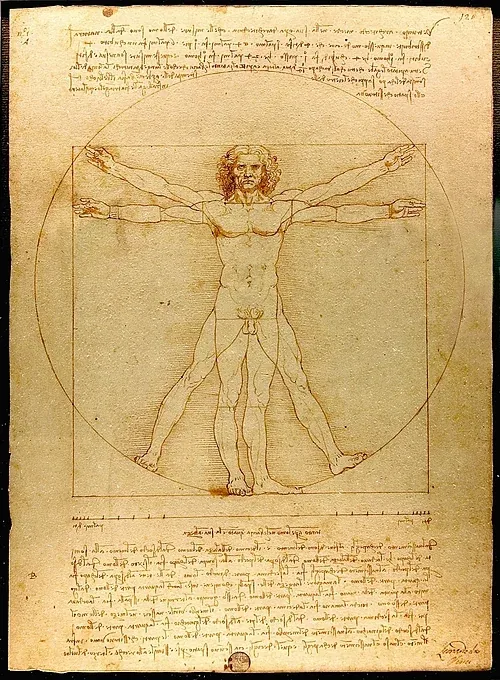
What Vitruvius wrote
In De Architectura III.1.3 (c. 15 BC), Vitruvius states that a man lying on his back with arms and legs extended fits a circle centred on the navel, and that his height equals his arm-span, so that he also fits a square. The passage is a statement about proportion, offered as a model for the proportions of temples. Read strictly, it requires the circle and the square to share a centre.
What Leonardo drew
Leonardo’s drawing of about 1490, known as the Vitruvian Man, follows Vitruvius in inscribing the figure in both shapes at once—but departs from him in one respect. The circle is centred on the navel, as prescribed. The square is centred on the pubis. The two centres do not coincide; they are displaced vertically by approximately
Δ ≈ 0.08 s,
where s is the side of the square. The areas of the two figures are not equal either. Leonardo’s innovation, in other words, was to let the two figures have different centres, and the literature has proposed anatomical, aesthetic and numerological explanations for why.
A calibration, not an anatomy
The paper On the Circlefication of a Square proposes that the drawing is not an anatomical study but a calibration diagram. The observer stands inside the square with arms outstretched to touch the circle. The circle is what the observer perceives; the square is what the observer is. The vertical displacement of the two centres,
ΔV ≈ 0.08 s,
is the Vitruvian offset: the perceptual bias by which any embodied observer displaces the centre of a circlefied square. It is recorded on the only instrument every observer possesses—the observer’s own body.
Where the offset is used
The lunar cube’s edge can be estimated in two independent ways. Conserving volume with the IAU mean lunar radius gives an edge of 2800.7 km; conserving mean radius instead gives 2844.9 km. The two estimates differ by 1.6 %, which is of the order of the Vitruvian offset. The paper adopts the volume-conserving value and attributes the residual to the same perceptual bias Leonardo measured. The full computation is on the page How big is the lunar cube?
Stage V of circlefication
The paper reinterprets five historical constructions as successive stages of one circlefication operator: Rödel’s parallel translation, the ½·r·√π construction, Ramanujan’s two approximations, and Leonardo’s drawing. The first four concern the shape of the circlefied square. Leonardo’s concerns its position: where an observer will believe the centre of the Moon to be. It is the last stage because it is the one that involves the observer directly.
Dante’s geometer
The Vitruvian Man is not the only Renaissance document the Society reads this way. At the climax of the Paradiso (XXXIII, 133–135, c. 1320), Dante compares himself to “the geometer who wholly applies himself to measure the circle, and finds not, by thinking, the principle he needs.” He is, at that moment, looking at the light of Heaven, which medieval cosmology placed beyond the sphere of the Moon. The geometer fails, in Dante’s account, not because the circle is unmeasurable but because what he is measuring is not a circle. A fuller account is in the history of squaring the circle.