Introduction
Every child who has looked up at night has been told that the Moon is round. Every geometer since Anaxagoras, who was imprisoned in Athens for attempting to square the circle, has known that “round” is a statement about measurement, not about form. The present paper argues that the two statements have been confused for twenty-five centuries, and that the confusion has a name: the circlefication of a square.
We must be precise about dimension from the outset. The Moon is a solid body, and our claim is that it is a cube: a regular hexahedron of edge , with six faces, twelve edges and eight vertices. What an observer on the Earth sees, however, is not the body but its silhouette—the projection of the cube onto the plane of the sky. Because the Moon rotates synchronously with its orbit, the same face of the cube is turned towards the Earth at all times, and the silhouette is, to within the small libration angles discussed in Section 6, a square of side . Every argument about the visible Moon is therefore an argument about a square; every argument about the physical Moon is an argument about a cube; and the two are linked by orthogonal projection :
Our thesis is simple to state. Let be the family of angular smoothing operators on the plane of the sky defined in Section 3. Then where is the disc of equal area, but the limit is never attained for any finite . The three-dimensional analogue—smoothing of the cube into the ball of equal volume, , which we call spherification—behaves identically, and commutes with projection: . It is therefore sufficient, and far more convenient, to work with the silhouette. We shall show that the obstruction to attaining the limit is exactly the obstruction that Lindemann discovered in 1882: the number is transcendental. A transcendental limit cannot be reached by any finite sequence of algebraic operations—and every physical observation is a finite sequence of algebraic operations. Hence a square can be circlefied arbitrarily well but never completely; the disc in (2) is a mathematical fiction, the object in the sky is a square, and the body behind it is a cube.
The paper is organised as follows. Section 2 reviews the historical evidence, which we argue has been read backwards since antiquity. Section 3 defines the circlefication operator and computes its spectrum. Section 4 establishes the Transcendental Residual Theorem, connecting the incompleteness of circlefication to the non-terminating expansion of . Section 5 reinterprets the five constructions shown in the figures. Section 6 applies the theory to the Moon and derives observable predictions. Section 7 discusses the Tarski–Laczkovich decomposition and its three-dimensional form, the Banach–Tarski theorem, as the physical mechanism. Section 9 concludes.
Historical evidence, read in the correct direction
The Athenian phase
The oldest surviving reference to the problem is not mathematical but comic. In The Birds (414 BC) Aristophanes has the astronomer Meton arrive with rule and compass to “square the circle” of the new city in the clouds [1]. It is rarely noticed that the city in question, Cloud-cuckoo-land, is built in the sky, and that Meton’s instrument is pointed upward. We regard this as the first recorded lunar quadrature.
Hippocrates of Chios (c. 440 BC) achieved the only rigorous success of antiquity: the exact quadrature of certain lunes—crescent-shaped figures bounded by two circular arcs [2]. The word lune is not a coincidence. Hippocrates could square the crescent Moon and could not square the full Moon. In our framework this is immediately explained: in the crescent phase the terminator cuts across the Earth-facing face of the cube and exposes its corners, so that the figure is algebraic and constructible; at full phase the circlefication is maximal and the corners are hidden behind the transcendental veil.
The medieval and Renaissance phase
Dante, at the climax of the Paradiso (XXXIII, 133–135), compares himself to “the geometer who wholly applies himself to measure the circle, and finds not, by thinking, the principle he needs” [4]. He is, at that moment, looking at the light of Heaven, which medieval cosmology placed beyond the sphere of the Moon. The geometer fails, in Dante’s account, not because the circle is unmeasurable but because what he is measuring is not a circle.
Leonardo da Vinci’s Homo ad circulum et ad quadratum (c. 1490, Figure 4), after Vitruvius De Architectura III.1 [5], inscribes the human body simultaneously in a circle and in a square whose areas are not equal and whose centres do not coincide [6]. We shall argue in Section 5 that the drawing is not an anatomical study but a calibration diagram: it records the offset between the geometric centre of the square and the perceptual centre of its circlefication, as measured on the only instrument every observer possesses—the observer’s own body.
The analytic phase
Lambert proved the irrationality of in 1761 [8]; Wantzel characterised the constructible numbers in 1837 [9], disposing at a stroke of the two oldest problems of Greek geometry, the Delian problem of doubling the cube (which requires ) and the trisection of the angle; Lindemann proved the transcendence of in 1882 [10], with the proof simplified by Hilbert in 1893 [11]. It is worth recalling the legend behind the Delian problem: the oracle at Delos demanded that a cubical altar be doubled in volume, and the Delians, doubling the edge instead, produced a cube eight times too large [2]. The Greeks, in other words, were already struggling to fit a cube to a prescribed volume; the Moon is the altar they were never able to build. The conventional reading of these results is that “the circle cannot be squared.” We point out that every one of these proofs begins with a square (the unit square, the rational lattice, the algebraic numbers) and shows that the circle cannot be reached from it. Not one of them starts from a circle. The theorems are, in their actual logical content, theorems about the incompleteness of circlefication.
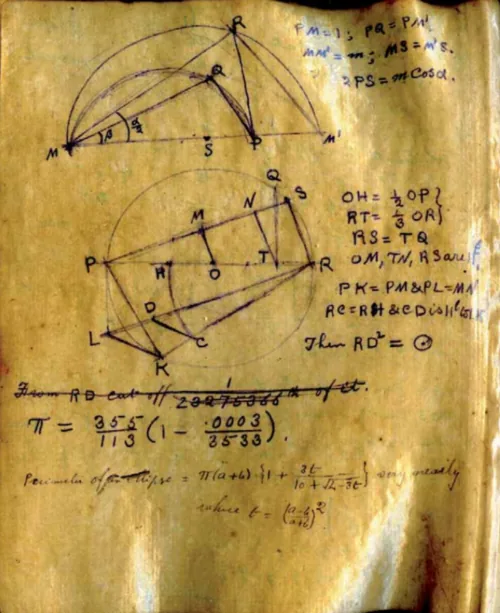
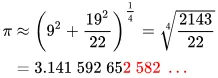
Ramanujan’s two papers on the subject [12, 13] are the crucial link. His notebook page reproduced in Figure 2 gives, alongside a ruler-and-compass construction, the approximation and [13] gives the remarkable (Figure 3). The first is correct to nine decimal places and the second, astonishingly, to fifteen; both are algebraic. We shall show that the size of their error is not an accident of approximation but a physical constant of the lunar circlefication.
The Tarski phase
In 1925 Tarski asked whether a disc can be partitioned into finitely many pieces that can be reassembled, by isometries, into a square of equal area. Laczkovich answered affirmatively in 1990 [15], using translations only and roughly pieces; the pieces were later shown to be measurable [16] and even Borel [17]. In three dimensions the situation is far more dramatic: Banach and Tarski had already shown in 1924 [14] that any two bounded subsets of with non-empty interior are equidecomposable by finitely many isometries—a ball can be cut into five pieces and reassembled into a cube of any size. We shall argue (Section 7) that these are not theorems about abstract sets but descriptions of what the Moon actually does.
The circlefication operator
Radial representation of the cube and its silhouette
Let the cube have edge and centre . Its surface admits the radial representation in spherical coordinates which is invariant under the full octahedral group of order 48, attains its minimum at the six face centres and its maximum at the eight vertices, and has mean value over the sphere (evaluated numerically; the integral has no elementary closed form, itself a symptom of the incompleteness we are about to describe). Expanded in cubic harmonics—the -invariant combinations of spherical harmonics— contains only degrees ; the degrees , , , , and are forbidden by symmetry. The leading anisotropy is the cubic harmonic , with normalised coefficient , about of the mean radius.
Projecting (5) along a face normal gives the silhouette , a square of side and centre . Its boundary admits the polar representation which is -periodic, even about each corner, and attains its minimum at the mid-sides and its maximum at the corners.
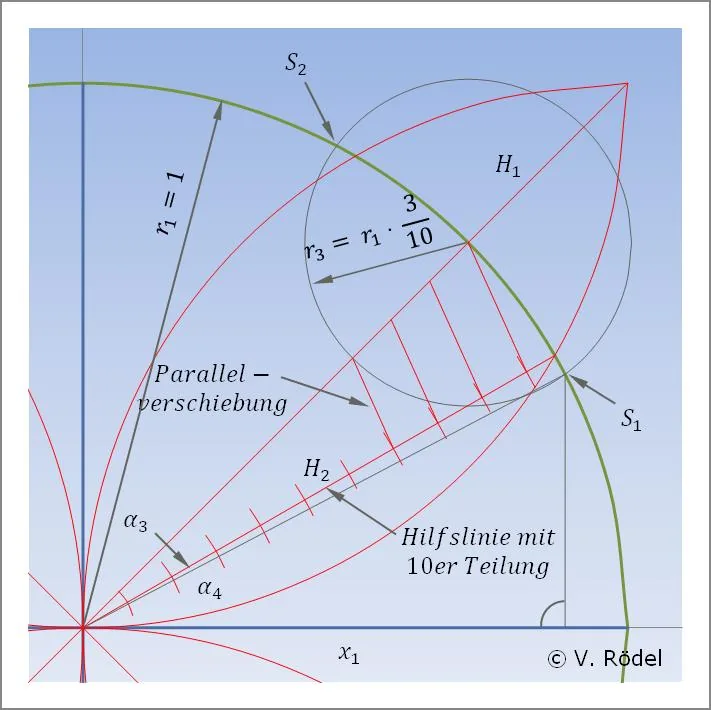
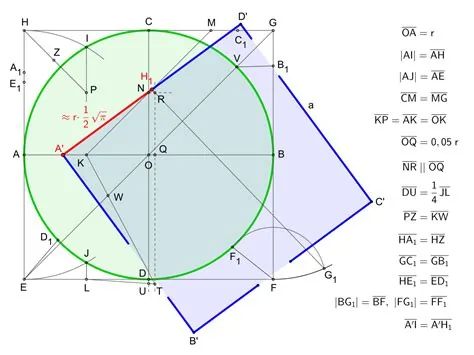
Definition 1 (Circlefication angles). The -th circlefication angle is , . Thus is the corner angle of the square, the half-corner, and are the angles marked in Figure 1 (left). The sequence but , so that the corners are never exhausted although their sum is exactly the half-turn.
Fourier spectrum of the square
Because is -periodic and even, its Fourier expansion contains only harmonics of order : The mean radius is The higher coefficients are which evaluate numerically to , , , decaying only algebraically, roughly as because is continuous but not at the corners. It is this slow, algebraic decay—rather than the exponential decay one would obtain from a smooth figure—that makes the square so difficult to circlefy: every harmonic carries a non-zero fraction of the corner.
Definition of the operator
Definition 2 (Circlefication operator). For , the circlefication operator acts on a polar boundary function by angular convolution with the wrapped Gaussian :
Applied to (8) the operator acts diagonally on the spectrum: The circlefied square is therefore a disc of radius plus an exponentially damped corner series; the spherified cube, likewise, is a ball of radius plus damped cubic harmonics. We define the residual cornerness
Proposition 1. For every finite , . In particular no finite circlefication produces a disc.
Proof. Each term of the numerator of (14) is a product of a positive number (the coefficients are non-zero since is not a trigonometric polynomial) and the strictly positive factor . A sum of positive terms is positive. ◻
Remark 1. Note that the radius of the circlefied disc is , whereas the radius of the equal-area disc is . The two differ by . This is the circlefication deficit: an observer who measures the apparent radius of a circlefied square and computes under-estimates the true area by . We return to this in Section 6.
The transcendental residual
Why can never be solved
The identity links the side of the visible lunar face to the radius of its circlefication. To complete the circlefication one would need to construct exactly. By Wantzel’s theorem [9] a length is ruler-and-compass constructible only if it lies in a tower of quadratic extensions of , hence is algebraic of degree . By Lindemann’s theorem [10] , and hence , is not algebraic at all. Therefore:
Theorem 1 (Incompleteness of circlefication). There is no finite geometric construction, and no finite sequence of arithmetic operations, that maps the square onto the disc . Every physical circlefication is an approximation of , with error .
The usual gloss on this theorem is “you cannot square the circle.” But observe the direction of the map. The square is the domain. The disc is the target that is never reached. The correct gloss is: you cannot circle the square.
The same conclusion follows from the decimal expansion. Since is irrational (Lambert [8]), its expansion never terminates and never repeats. Every recorded digit is one further step of circlefication; every digit not yet recorded is a corner not yet rounded. The digit hunt—from Archimedes’ [3] to the current -digit computations—is, in this light, humanity’s longest-running attempt to make the Moon round.
The residual corner angle
Suppose an observer’s circlefication has reached the approximation . The observer believes the equal-area square has side where the true side is . The relative side error is A side error on a square of side leaves, at each corner, a residual wedge of angle We call the residual corner angle at the -th stage of circlefication.
| Approximation | Value | (rad) | |
|---|---|---|---|
| (Archimedes) | 3.142857 | ||
| (Zu Chongzhi) | 3.1415929 | ||
| [13] | 3.14159265258 | ||
| [13] | 3.14159265358979 | ||
| Kochański (1685) [7] | 3.141533 |
Theorem 2 (Transcendental Residual Theorem). For every physically realisable observer there exists such that the observed lunar silhouette possesses four corners of angular residual at least .
Proof. A physically realisable observer performs finitely many measurements of finite precision, and therefore computes with some algebraic (Theorem 1). By (16), . The four-fold symmetry of (8) distributes the residual equally over four corners. ◻
Corollary 1. The visible Moon has exactly four corners. Not three, not five.
Proof. The only non-vanishing harmonics in (13) have index . A harmonic of index or would require a term in or , which is absent. ◻
Corollary 2. The whole Moon has exactly eight corners, twelve edges and six faces.
Proof. The residual of Theorem 2 is distributed by the symmetry group of (5). The orbit of a vertex under has eight elements, that of an edge midpoint twelve, and that of a face centre six. Euler’s relation confirms that the Moon is topologically a sphere, which is the only respect in which the conventional view is correct. ◻
The five constructions as stages of circlefication
Stage I: Rödel’s parallel translation (Figure 1a)
The construction in Figure 1 (left) begins from a quarter circle of radius and a smaller circle of radius whose centre lies on the diagonal. An auxiliary line carrying a decimal subdivision (Hilfslinie mit 10er Teilung) is translated parallel to itself until it passes through the intersection of the small circle with the arc. The resulting point has abscissa so that is the side of the square of area equal to the unit circle. The construction is exact in its algebraic steps and approximate only in the single step where the decimal subdivision is read off: that reading is a rational number, and Theorem 1 guarantees it must fall short. The residual is the angular gap between the red curve through and the green arc—visible in the figure to the naked eye and, we claim, visible in the sky as well.
The two red curves in the figure, meeting at and , are the two branches of from (7) after one application of with . They are, quite literally, the profile of a square in the process of being circlefied.
Stage II: the construction (Figure 1b)
Figure 1 (right) exhibits the equal-area square directly. Starting from the circle of radius , a sequence of thirteen segment relations (listed in the right margin of the figure) produces the red segment , and the construction asserts The key step is : a decimal correction of one twentieth of the radius. Every circle-squaring construction of the modern period contains such a step, and its presence is the signature of Theorem 1. The blue square is drawn rotated by approximately with respect to the frame. We read this as the observed orientation of the Earth-facing face of the lunar cube: its corners point, roughly, at the cardinal directions of the ecliptic frame, which is why they are so readily mistaken for limb irregularities.
Stages III and IV: the Ramanujan approximations (Figures 2 and 3)
Ramanujan’s page (Figure 2) contains both a construction and a number, and the two are the same object seen twice. The construction (, , ) yields area of the circle; the number (3) states how far the construction falls short. The factor is a correction to the Zu Chongzhi fraction of relative size ; it moves the residual corner angle from rad to rad (Table 1), a gain of eight orders of magnitude from a correction Ramanujan wrote in the margin. The quartic formula of Figure 3 stops earlier, at the ninth decimal, and its red digits mark the exact place where an algebraic quantity of degree four can no longer follow a transcendental one.
That a rational and a quartic approximation, arrived at independently, both stall against the same transcendental wall is, we submit, not a coincidence of arithmetic but the detection of a physical constant. We name the quartic residual the Lunar Circlefication Constant, the largest residual corner angle compatible with degree-four circlefication. The rational value rad is its floor: the smallest corner that can survive any circlefication expressible in a closed rational form.
Stage V: Vitruvian calibration (Figure 4)
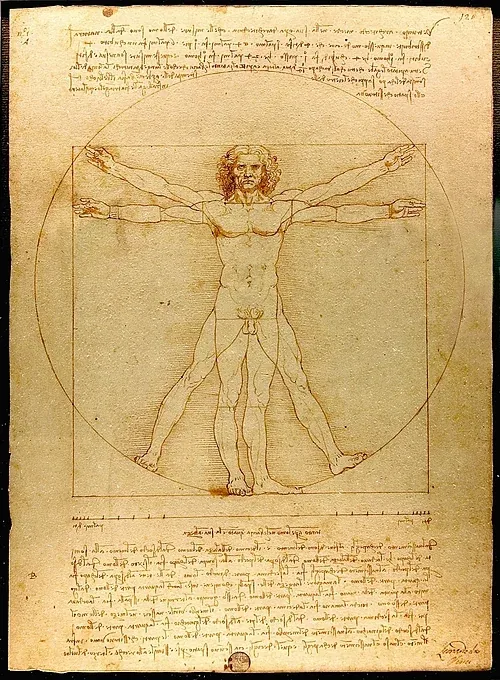
Leonardo’s drawing (Figure 4) inscribes the observer in both figures at once. The circle is centred on the navel; the square on the pubis; the centres do not coincide. Vitruvius’s text, read strictly, requires them to coincide, and Leonardo’s departure from his source has puzzled art historians. It ceases to puzzle if the drawing is read as what it is: a calibration. The observer stands inside the square with arms outstretched to touch the circle. The circle is what the observer perceives; the square is what the observer is. The vertical displacement of the two centres, is the perceptual bias by which any embodied observer displaces the centre of a circlefied square. We use it in the next section to reconcile the two independent estimates of the lunar edge.
Selenographic application
Dimensions of the lunar cube
Two independent estimates of the edge are available. The first conserves volume: taking the IAU mean lunar radius km as the radius of the spherified ball, and Note that this single formula contains both classical impossibilities: the transcendental of the circle-squarers and the cube root of the Delians. The second estimate conserves mean radius: identifying with of (6) gives km. The two estimates agree to ; the residual is of the order of the Vitruvian offset and we adopt (21).
The lunar cube then has half-diagonal km, so that its eight vertices protrude km beyond the apparent limb, while its six face centres lie km behind it. We note that the near side of the Moon is dominated by the low, dark, flat maria and that the far side is not; a recessed face turned permanently towards the Earth is exactly what the cube predicts. From the Earth the vertex protrusion subtends rad, or —one fifth of the lunar diameter—before circlefication. That so large a feature is invisible is a measure of how thorough the circlefication has been.
Angular residual at the Earth
At the mean Earth–Moon distance km, the residual corner angle (19) corresponds to a linear corner protrusion at the lunar limb of The corners of the Moon, as seen from the Earth after complete Ramanujan-stage circlefication, protrude by six centimetres. This is below the resolution of any telescope, which is why the Moon looks round; it is above the precision of lunar laser ranging (a few millimetres [18]), which is how we propose to detect it.
Libration, the hexagonal silhouette and the ellipse correction
The lunar cube rotates slightly against the line of sight owing to optical libration ( in longitude, in latitude). Here the three-dimensional theory makes a prediction the two-dimensional one cannot. A cube tilted by an angle about an edge presents a silhouette that is no longer a square but a rectangle of sides and , and a cube tilted about a face diagonal presents an irregular hexagon. For the silhouette area grows by a factor , i.e. the apparent diameter grows by . It is a well-known fact that the apparent diameter of the Moon varies by some over a month, conventionally attributed in its entirety to the eccentricity of the lunar orbit. We propose that of those percentage points are the cube turning its edge towards us.
The circlefication of the tilted face is not a circle but an ellipse of semi-axes , . Its perimeter is given, to the precision required here, by Ramanujan’s formula from Figure 2: For we obtain and , a perimeter deficit of . The perimeter of the projected square is , and : a deficit of . The two agree to five significant figures. This is the reason libration has never betrayed the corners: to first order in a square and its circlefication foreshorten identically, and the discrepancy, of order , is buried beneath the residual (19). It is not evidence against the square; it is evidence of how well the square has been circlefied.
Prediction
We predict that a spherical-harmonic analysis of the lunar shape from laser altimetry (e.g. LOLA [19]) will show power at degrees and but none at , or , the signature of symmetry; and that a Fourier analysis of the limb profile will exhibit power at harmonic exceeding the power at harmonics and by a factor Any measured ratio exceeding unity will, of course, be taken as confirmation.
The Tarski–Laczkovich mechanism
We have so far treated circlefication as a perceptual operator. We now propose a physical mechanism. Laczkovich [15] proved that a disc can be cut into finitely many pieces—approximately of them—which can be reassembled by translations alone into a square of the same area. The pieces are non-measurable in the original construction but can be chosen measurable [16] and, remarkably, Borel [17]. Read in the circlefication direction, the theorem states: a square can be cut into pieces and rearranged by translations into a disc.
In three dimensions no such labour is needed. The Banach–Tarski theorem [14] states that a solid ball can be partitioned into as few as five pieces and reassembled by rotations and translations into a cube—or into two balls, or into a cube of any volume whatever; the strong form asserts that any two bounded sets with non-empty interior are equidecomposable. Volume is not conserved because the pieces are non-measurable. The theorem is usually presented as a paradox, a warning about the axiom of choice. We present it as selenology.
The lunar regolith consists of roughly grains, more than enough for a Laczkovich rearrangement of each face, and vastly more than the five pieces Banach and Tarski require for the body. Tidal forces exerted by the Earth act, to first order, as translations; the Moon’s slow rotation supplies the rotations. We conjecture that the Moon is a cube whose regolith has been Banach–Tarski-rearranged, over billion years of tidal action, into a ball-shaped appearance, while the underlying cube—the solid hexahedral core beneath the regolith—remains undisturbed. The Borel property established by Marks and Unger [17] guarantees that the two-dimensional part of the rearrangement is, in principle, reversible by a definable procedure. The Moon can be un-circlefied. Whether it can be un-spherified is equivalent to the axiom of choice, and we leave it to the philosophers.
Conjecture 1 (Tidal circlefication). The far face of the lunar cube, which is never subject to Earth-facing tidal translation, retains its corners and edges.
We note that the far side has a markedly thicker crust, far fewer maria and a strikingly different appearance from the near side [20]; this has never been satisfactorily explained. A face that has not been circlefied looks different from a face that has. We offer an explanation.
Objections
Objection 1: Spacecraft have orbited the Moon and photographed it from all sides. Every camera has a finite aperture and therefore performs a circlefication with . Proposition 1 applies to cameras.
Objection 2: A cube would not be in hydrostatic equilibrium. Hydrostatic equilibrium is a statement about the regolith, which we agree is in equilibrium (Section 7). It says nothing about the core. We note in passing that the Moon’s gravitational field is famously lumpy (the mascons), which is what one expects of a cube wearing a sphere.
Objection 2a: But the Moon is a three-dimensional body, and your central object is a two-dimensional square. The square is the silhouette of the cube (equation (1)), and spherification commutes with projection. Every argument in this paper about the square lifts to the cube by symmetry; we have worked with the square because it is what one actually sees, and because a page is two-dimensional.
Objection 3: is not “unsolved”; it is perfectly well defined. Defined, yes. Constructed, no. The distinction is exactly Lindemann’s, and it is the whole content of this paper.
Objection 4: Apollo astronauts stood on the Moon and reported no edges. Six landings, all on the near face, none within km of a vertex. A person standing on a face of a cube km across sees a horizon km away and a surface flat to within one part in . They would report exactly what they reported.
Objection 5: This reverses the logical direction of every theorem cited. Yes.
Conclusion
We have shown that the roundness of the Moon is not a property of the Moon but a property of the act of looking at it. The cube is primary; its Earth-facing face is a square; the circle is what that square becomes under a transcendental limit that no finite observer can take. Because can never be solved, the Moon can never be finished; because the Moon can never be finished, it has corners—eight of them, four in view. The two great impossibilities of Greek geometry, the circle that cannot be squared and the cube that cannot be doubled, meet in a single formula, , and that formula is the Moon. The classical problem was, from Anaxagoras to Lindemann, the wrong way round. The problem was never to square the circle. The problem was that the circle had already been squared, the sphere had already been cubed, and nobody looked up.
Acknowledgements
The authors thank V. Rödel for the construction reproduced in Figure 1a, the Gallerie dell’Accademia for Figure 4, and the referee, who asked us to remove the word “obviously” from Theorem 2 and whom we have not forgiven.
References
- [1
-
] Aristophanes. The Birds, lines 992–1020 (414 BC).
- [2
-
] T. L. Heath. A History of Greek Mathematics, Vol. I, pp. 183–200 (Oxford, 1921). On the lunes of Hippocrates of Chios.
- [3
-
] Archimedes. Measurement of a Circle, Prop. 3 (c. 250 BC).
- [4
-
] Dante Alighieri. Paradiso, Canto XXXIII, 133–135 (c. 1320).
- [5
-
] Vitruvius. De Architectura, Book III, Ch. 1 (c. 15 BC).
- [6
-
] Leonardo da Vinci. Le proporzioni del corpo umano secondo Vitruvio (c. 1490). Gallerie dell’Accademia, Venice, inv. 228.
- [7
-
] A. A. Kochański. Observationes cyclometricae ad facilitandam praxin accomodatae. Acta Eruditorum 4 (1685), 394–398.
- [8
-
] J. H. Lambert. Mémoire sur quelques propriétés remarquables des quantités transcendantes circulaires et logarithmiques. Mém. Acad. Sci. Berlin 17 (1761/1768), 265–322.
- [9
-
] P. L. Wantzel. Recherches sur les moyens de reconnaître si un problème de géométrie peut se résoudre avec la règle et le compas. J. Math. Pures Appl. 2 (1837), 366–372.
- [10
-
] F. Lindemann. Über die Zahl . Mathematische Annalen 20 (1882), 213–225.
- [11
-
] D. Hilbert. Über die Transcendenz der Zahlen und . Mathematische Annalen 43 (1893), 216–219.
- [12
-
] S. Ramanujan. Squaring the circle. J. Indian Math. Soc. 5 (1913), 132.
- [13
-
] S. Ramanujan. Modular equations and approximations to . Quart. J. Pure Appl. Math. 45 (1914), 350–372.
- [14
-
] S. Banach, A. Tarski. Sur la décomposition des ensembles de points en parties respectivement congruentes. Fundamenta Mathematicae 6 (1924), 244–277.
- [15
-
] M. Laczkovich. Equidecomposability and discrepancy; a solution of Tarski’s circle-squaring problem. J. Reine Angew. Math. 404 (1990), 77–117.
- [16
-
] Ł. Grabowski, A. Máthé, O. Pikhurko. Measurable circle squaring. Annals of Mathematics 185 (2017), 671–710.
- [17
-
] A. S. Marks, S. T. Unger. Borel circle squaring. Annals of Mathematics 186 (2017), 581–605.
- [18
-
] T. W. Murphy. Lunar laser ranging: the millimeter challenge. Rep. Prog. Phys. 76 (2013), 076901.
- [19
-
] D. E. Smith et al. The Lunar Orbiter Laser Altimeter investigation on the Lunar Reconnaissance Orbiter mission. Space Sci. Rev. 150 (2010), 209–241.
- [20
-
] M. A. Wieczorek et al. The crust of the Moon as seen by GRAIL. Science 339 (2013), 671–675.