Proceedings of the Square Moon Society · Notes
A History of Squaring the Circle, Read in the Correct Direction
For twenty-five centuries geometers have tried to build a square equal in area to a given circle. The Society’s contention is that every one of them was working from the square towards the circle, and that the record makes more sense once you notice.
The Athenian phase
The oldest surviving reference to the problem is not mathematical but comic. In The Birds (414 BC) Aristophanes has the astronomer Meton arrive with rule and compass to “square the circle” of the new city in the clouds. It is rarely noticed that the city in question, Cloud-cuckoo-land, is built in the sky, and that Meton’s instrument is pointed upward. The paper regards this as the first recorded lunar quadrature.
Anaxagoras, according to Plutarch, worked on the problem while imprisoned in Athens. Hippocrates of Chios (c. 440 BC) achieved the only rigorous success of antiquity: the exact quadrature of certain lunes—crescent-shaped figures bounded by two circular arcs. Hippocrates could square the crescent and could not square the full disc. The word lune is, in the Society’s reading, not a coincidence: in the crescent phase the terminator cuts across the Earth-facing face of the cube and exposes its corners, so the figure is algebraic and constructible; at full phase the circlefication is maximal and the corners are hidden.
Archimedes (c. 250 BC), in Measurement of a Circle, bounded π between 3 10/71 and 3 1/7—the first entry in a digit hunt that has not stopped since.
The Delian problem
The oracle at Delos, so the legend runs, demanded that a cubical altar be doubled in volume. The Delians doubled the edge instead and produced a cube eight times too large. Doubling the cube requires constructing the cube root of 2, which Wantzel proved impossible in 1837. The Greeks, in other words, were already struggling to fit a cube to a prescribed volume. The Moon is the altar they were never able to build: its edge, aM = rM(4π/3)1/3, contains both the circle-squarer’s π and the Delian cube root.
The medieval and Renaissance phase
Dante, at the climax of the Paradiso (XXXIII, 133–135), compares himself to “the geometer who wholly applies himself to measure the circle, and finds not, by thinking, the principle he needs.” He is at that moment looking at the light of Heaven, which medieval cosmology placed beyond the sphere of the Moon. The geometer fails not because the circle is unmeasurable but because what he is measuring is not a circle.
Leonardo da Vinci’s Homo ad circulum et ad quadratum (c. 1490), after Vitruvius, inscribes the human body in a circle and a square whose areas are not equal and whose centres do not coincide. The Society reads it as a calibration diagram; see the geometry of the Vitruvian Man.
The age of approximate constructions
Once it was suspected that an exact quadrature was impossible, geometers turned to approximate ones: ruler-and-compass constructions producing a segment close to r√π. Adam Adamandy Kochański, a Jesuit and librarian to the King of Poland, published one in the Acta Eruditorum in 1685 that gives π ≈ 3.141533, accurate to four decimals.
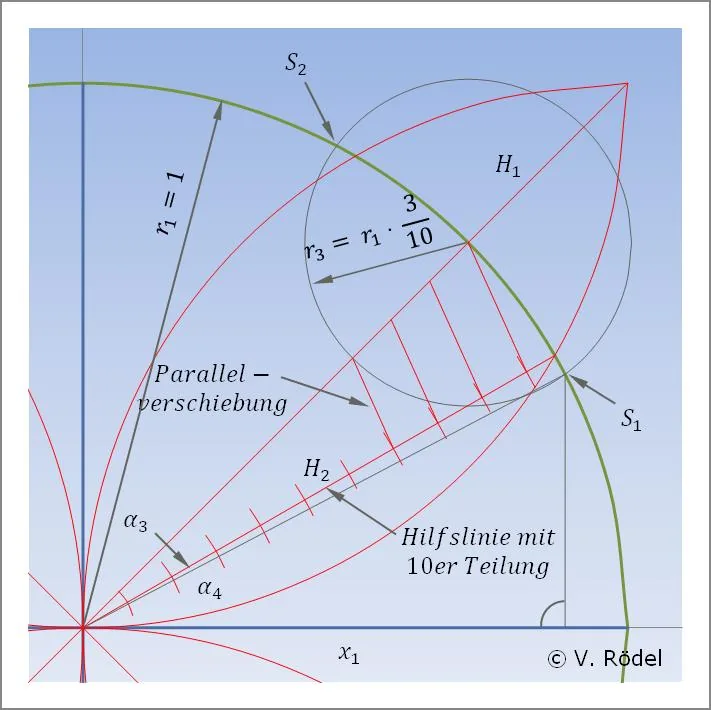
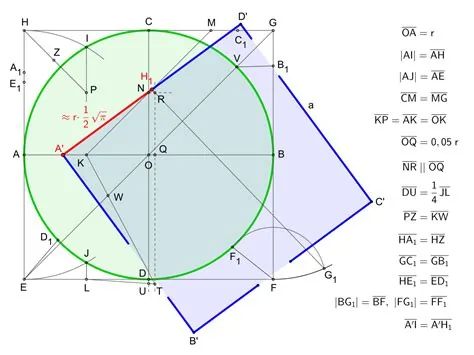
Rödel’s construction is exact in its algebraic steps and approximate only in the single step where a decimal subdivision is read off. A companion construction, the ½·r·√π construction, produces the equal-area square directly through a chain of thirteen segment relations, the key one being a correction of one twentieth of the radius. Every circle-squaring construction of the modern period contains such a decimal step, and the paper treats its presence as the signature of Lindemann’s theorem: the place where an algebraic construction must fall short of a transcendental target.
The analytic phase
Lambert proved π irrational in 1761. Wantzel characterised the constructible numbers in 1837, disposing of the Delian problem and the trisection of the angle at a stroke. Lindemann proved π transcendental in 1882, Hilbert simplified the proof in 1893, and the problem of squaring the circle was formally closed. Every one of these proofs starts from a square—the unit square, the rational lattice, the algebraic numbers—and shows that the circle cannot be reached from it. Not one starts from a circle. The details are on the page why π can never be solved.
The Indian and the Polish–Hungarian codas
Ramanujan (1913, 1914) supplied both a construction and two approximations of extraordinary accuracy, and is the crucial link between the geometric and the analytic traditions. Tarski (1925) and Laczkovich (1990) reopened the problem in a different key: not construction but decomposition, and found that with about 1050 pieces the circle can, after all, be squared.
Read backwards
The conventional summary of this history is that the circle cannot be squared. The Society’s summary is that the classical problem was, from Anaxagoras to Lindemann, the wrong way round. The problem was never to square the circle. The problem was that the circle had already been squared, the sphere had already been cubed, and nobody looked up.