Introduction
HER [1] introduced the circlefication operator as an angular convolution of the square silhouette with a wrapped Gaussian of width , showed that it acts diagonally on the Fourier harmonics of the square with damping , and proved that no finite yields a disc. EvHR [2] used the cube as a geodetic instrument. Neither paper said what is, or why the kernel should be Gaussian, or where in the chain from lunar regolith to conscious percept the smoothing takes place. The popular presentation reproduced in Figures 1 and 3 gives the answer in a phrase: it is not a lie, it is a lens. The present paper is the long form of that phrase.
We proceed along the optical path. Light leaves the face of the cube (Section 2), traverses the atmosphere (Section 3), enters an optical system—eye or camera—with a finite aperture and a non-rectilinear projection (Section 4), is sampled by a retina and mapped onto a cortex (Section 5), and is finally compared with (Section 6). At each stage we compute the contribution to and to the cornerness of HER. The result is a budget, and the budget has a striking feature: the physical optics account for only a twentieth of the observed roundness. The rest is done by the observer. This does not weaken the thesis of HER; it sharpens it. The Moon is a cube, the atmosphere and the eye round it a little, the brain rounds it a great deal, and forbids anyone to finish the job.

The source: a Lambertian face in vacuum
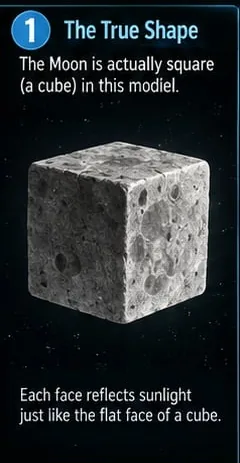
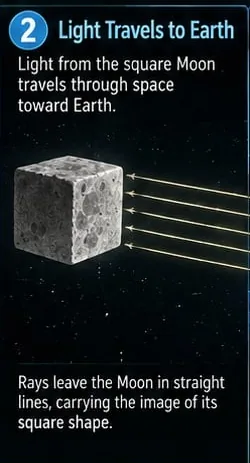
The Earth-facing face of , km, is a plane Lambertian radiator (EvHR, Section 6). In vacuum, a plane radiator at distance km subtends a solid angle and its image under a pinhole is an exact square of angular half-side with corners at angular radius . Nothing rounds it. Rays in vacuum are straight (panel 2), and a pinhole is the one optical system with no aperture blur. The square Moon of panel 1 is therefore not merely the true shape but the shape that would be seen by an observer with a pinhole camera above the atmosphere—which is, we note, roughly the situation of an astronaut, and we refer to HER, Objection 1, for why astronauts nevertheless report a disc: no real camera is a pinhole.
Stage I: the atmosphere as a gradient-index lens
Bouguer’s invariant
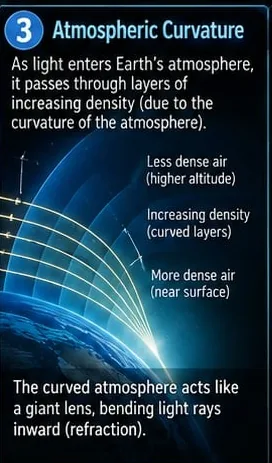
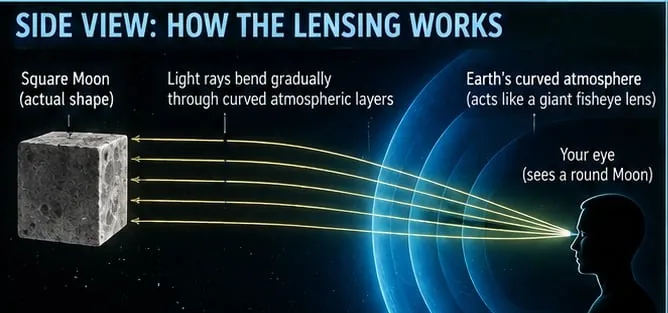
Let the atmosphere be spherically stratified with refractive index decreasing outward from at the surface to at infinity. For a ray in such a medium Fermat’s principle yields the invariant of Bouguer [6] where is the local zenith angle of the ray. Equation (2) is the optical form of angular-momentum conservation, and it is the sense in which panel 3 is exactly right: a spherically stratified medium is a lens, and the curvature of the Earth (EvHR) is what makes it one. On a planar Earth the strata would be planes, Snell’s law would give with no factor of , and a ray entering at zenith angle would leave at the same : a plane-parallel atmosphere refracts but does not lens. The atmosphere rounds the Moon only because the Earth is round.
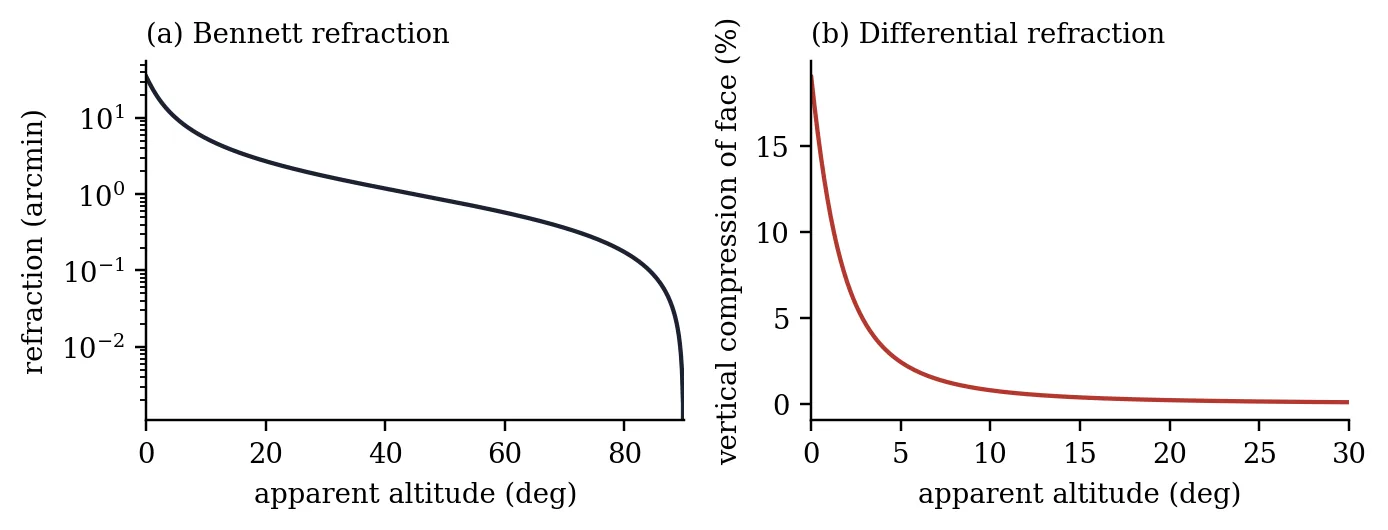
The total refraction of a ray arriving at apparent altitude is obtained by integrating (2) through the density profile; the standard closed-form fit is Bennett’s [17, 20] which gives at the horizon, at and at the zenith (Figure 2a).
Differential refraction: the corners move inward
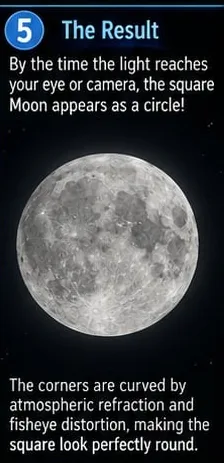
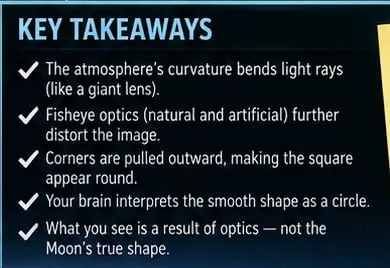
Refraction is a displacement, not a blur; a uniform displacement would leave the square a square. The rounding action comes from the gradient of across the vertical extent of the face: At the horizon this is : the setting cubic Moon is a rectangle shorter than it is wide, and every observer who has watched the Moon rise has seen this flattening (Figure 2b). At altitude it is , at it is . Two remarks follow. First, the effect is anisotropic: it acts on the vertical edges only and does nothing to round the corners; a rectangle has the same four right angles as a square. Second, the direction is inward—the top edge is pulled down towards the bottom—which corrects the popular statement (panel 5) that the corners are “pushed outward”. Refraction compresses; something else must redistribute, and we shall find it in Section 5.
The ideal atmosphere is Maxwell’s fish-eye
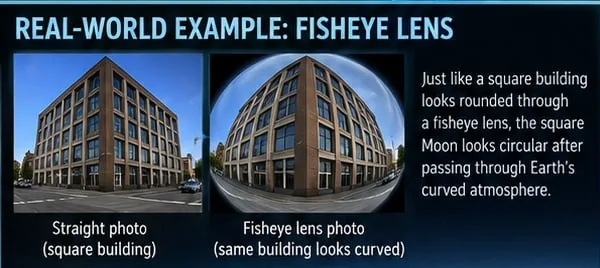
Panel 3 calls the atmosphere “a giant fisheye lens”. The phrase is more exact than its authors can have known. In 1854 Maxwell [10], answering a Cambridge examination problem, found the gradient-index profile for which every ray is a circle and every point is imaged perfectly onto a conjugate point: the fish-eye. The name is Maxwell’s; the lens is the stereographic projection of the geodesics of a sphere onto a plane [15]. A real atmosphere is not Maxwell’s, but the direction of the real profile is the same—dense below, thin above—and Bouguer’s invariant (2) is the first-order form of Maxwell’s exact ray-circles. We regard (5) as the ideal atmosphere: the profile a planet would need for its sky to be a perfect imaging system. The Earth’s atmosphere is a poor Maxwell fish-eye. It is nonetheless a fish-eye, and the term in panel 3 is correct.
Stage II: fisheye, aperture and the lemniscate constant
Non-rectilinear projection
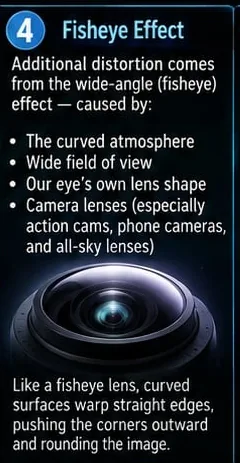
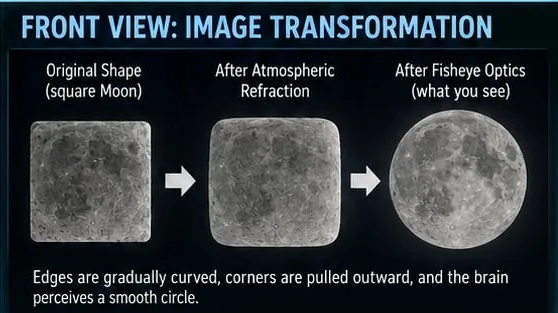
A rectilinear (pinhole) lens maps a field angle to image radius and preserves straight lines. A fisheye maps by (equidistant), (equisolid, Wood [12]) or (stereographic), and bends every straight line not through the axis into a curve (panel 4 and the building of Figure 3). For a small object centred on the axis, all radial mappings agree to second order and the distortion of a square of half-angle is of relative order . This is small, and for the eye—whose projection is close to over the fovea—it is negligible against the terms below. We record it and move on; but we note that panel 4 is right that action cameras and all-sky lenses, with over , will bend the lunar edges visibly when the Moon is off-axis, and that a great many recent photographs of the Moon were taken with exactly such lenses.
The exact lens: Schwarz–Christoffel
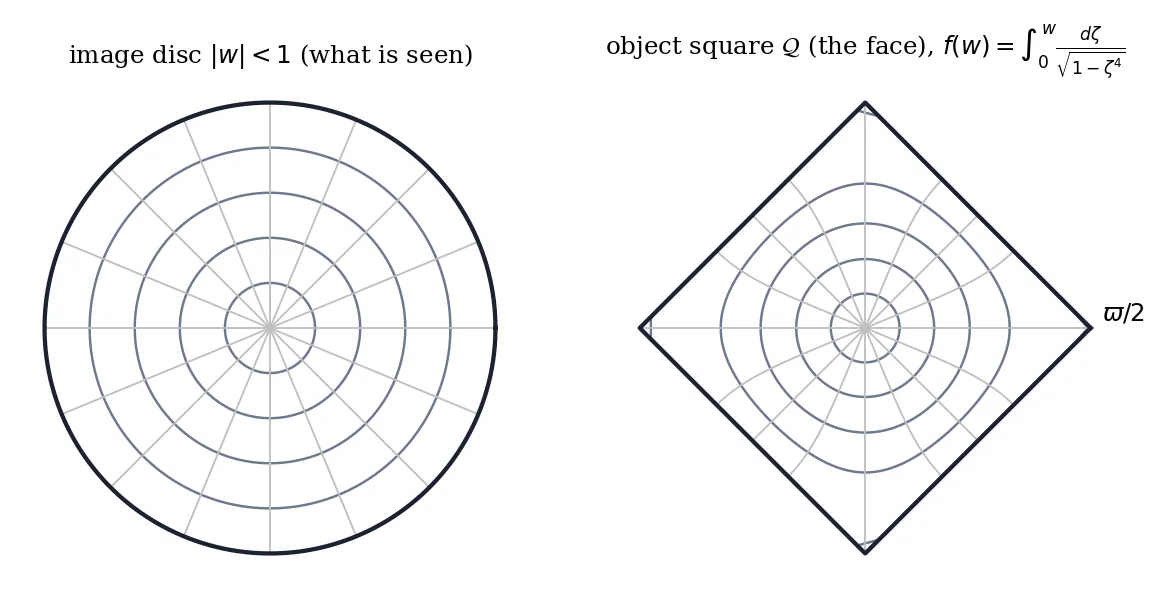
Suppose, with panel 5, that the observer really sees a perfect disc. What lens maps the square face onto it? The question is a classical one and has a classical answer. By the Riemann mapping theorem there is a unique conformal (angle-preserving, hence optically ideal) bijection from the unit disc onto a square, and Schwarz [11] wrote it down: The four branch points on the rim of the disc are sent to the four corners of the square (Figure 4); the square has its vertices on the axes at distance The number is the lemniscate constant: it is to the lemniscate of Bernoulli what is to the circle—the lemniscate has arc length exactly as the unit circle has circumference [8]. It is therefore the natural constant of the square in precisely the sense that is the natural constant of the disc, and equation (6) says that the ideal circlefying lens is the one that exchanges them.
Theorem 1 (Circlefication ratio). The ratio of the square’s constant to the disc’s constant under the ideal lens is Gauss’s constant, where is the arithmetic–geometric mean.
Proof. Gauss [8] showed on 30 May 1799 that , writing in his diary that the result “opens an entirely new field of analysis”. The identity follows from Landen’s transformation of the complete elliptic integral . ◻
Corollary 1. The circlefication ratio is transcendental, and so is .
Proof. , and is transcendental, indeed algebraically independent of (Chudnovsky [18]). ◻
This is the point at which the present paper rejoins HER. There it was shown that circlefication cannot be completed because is transcendental. We now see the same obstruction from the other side: the constant of the square, , is also transcendental, and the two are algebraically independent. No algebraic lens—no lens whose surfaces are described by polynomial equations, which is to say no lens that can be ground—can realise (6) exactly. Every real lens, the eye included, realises a rational approximation to it, and the difference between the approximation and the truth is the residual corner. It is, once more, not a lie. It is a lens, and lenses are algebraic.
The blur budget and the Gaussian kernel
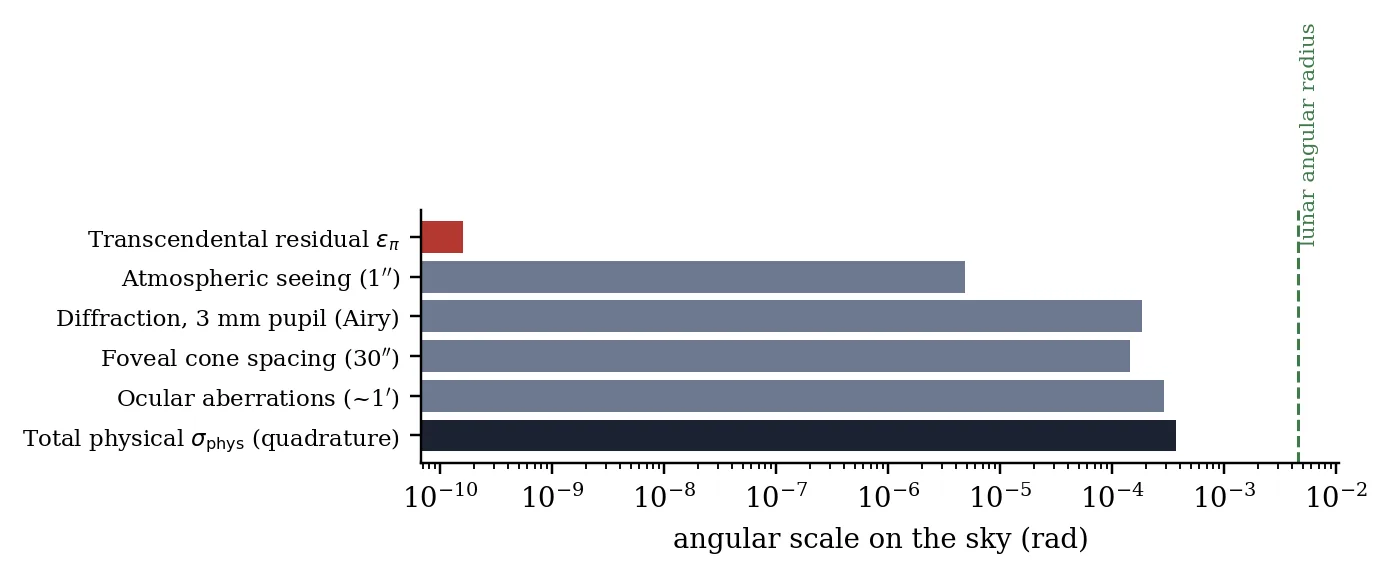
We now turn from geometry to resolution. A finite aperture, a turbulent atmosphere and a discrete retina each convolve the image with a kernel of their own. The kernels and their angular widths for a night-adapted eye of pupil mm at nm are collected in Table 1 and Figure 5.
| Stage | Kernel | (rad) |
|---|---|---|
| Diffraction, mm | Airy, | |
| Atmospheric seeing | Kolmogorov, | |
| Foveal cone spacing | top-hat, | |
| Ocular aberrations | Zernike, | |
| Fisheye distortion | radial, | |
| Total (quadrature) | Gaussian (CLT) | |
| Lunar angular radius | — | |
| Transcendental residual | — |
Proposition 1 (Gaussianity of the circlefication kernel). The composition of independent, zero-mean, finite-variance blur kernels converges, as grows, to a Gaussian of variance .
Proof. Convolution of densities is addition of independent random displacements; apply the central limit theorem [7]. ◻
Proposition 1 is the justification, missing from HER, for the Gaussian form of : the kernel is Gaussian not by assumption but because an eye is many blurs in series. The total is
How much rounding does physics buy?
HER’s operator acts on the polar angle around the silhouette. A sky blur of radians at angular radius rad corresponds to a polar smoothing and HER equation (13) damps the leading corner harmonic by
Theorem 2 (Insufficiency of optics). The physical optics of an unaided terrestrial observer remove of the fourth-harmonic cornerness of the lunar face. The remaining is not removed by the atmosphere, the eye or the camera.
Theorem 2 is the central quantitative result of this paper, and it is not what the popular presentation leads one to expect. The lens is real, and it does what panels 3 and 4 say it does; but it does it only to one part in twenty. If the Moon looks round—and it does—then something downstream of the retina is doing the other nineteen parts.
Stage III: the cortex as a fisheye
The complex-logarithmic retinotopic map
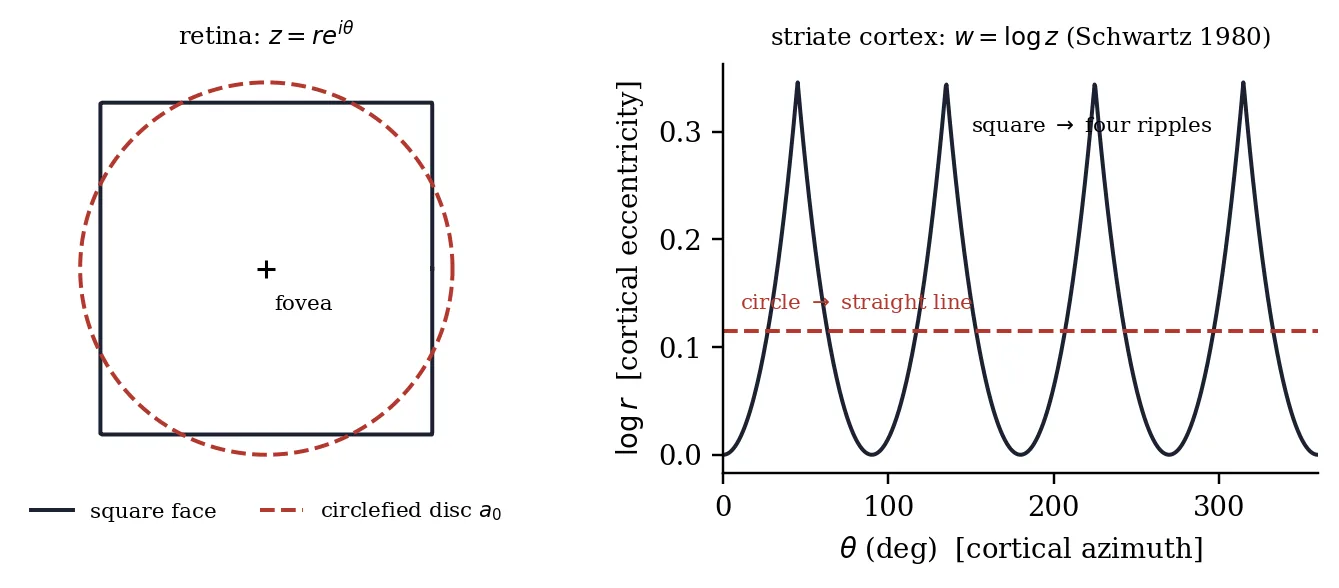
The image on the retina is mapped onto the primary visual cortex by a transformation that Schwartz [16] showed to be, to good approximation, the complex logarithm: Eccentricity from the fovea becomes one cortical coordinate, azimuth the other. The map is conformal, and it is a fisheye of a most extreme kind: it magnifies the fovea without bound and compresses the periphery logarithmically. What it does to shapes centred on the fovea is decisive (Figure 6):
Lemma 1. Under (12) a circle of radius centred on the fovea maps to the straight line . The square of half-side maps to the curve , where is the polar boundary function of HER equation (7), a periodic curve with four ripples of peak-to-trough height .
Proof. has constant real part. For the square, ranges from at mid-sides to at corners, and . ◻
Prägnanz as a low-pass filter
The Gestalt law of Prägnanz [13, 14] states that the perceptual system settles on the simplest, most regular organisation consistent with the input. In the cortical coordinates (12) the simplest curve is a straight line, and the simplest closed figure on the retina is therefore a circle. A cortex that flattens ripples in is a cortex that circlefies. We model Prägnanz as a Gaussian smoothing along the cortical -axis of width , and ask what width reproduces a percept whose residual cornerness is at the threshold of detection, : A cortical smoothing of in azimuth is almost exactly the half-period of the corner harmonic: the cortex smooths over one half-corner, which is the least it can do to remove the corner and the most it can do without destroying the fourfold structure that EvHR showed is still readable in the maria. We regard the coincidence (HER Definition 1) as the cortical signature of the second circlefication angle.
Composition
The three stages compose. Writing the polar-angle widths of the atmospheric, ocular and cortical Gaussians as (anisotropic, does not round), and , so and the cortex contributes of the variance. Panel 5’s “by the time the light reaches your eye or camera, the square Moon appears as a circle” is thus true of the percept and false of the retinal image: the retinal image of the Moon is a square with of its cornerness intact. The takeaway of the popular presentation that “your brain interprets the smooth shape as a circle” is the one that carries the weight.
The Lamé path and the transcendental floor
Circlefication as a one-parameter family
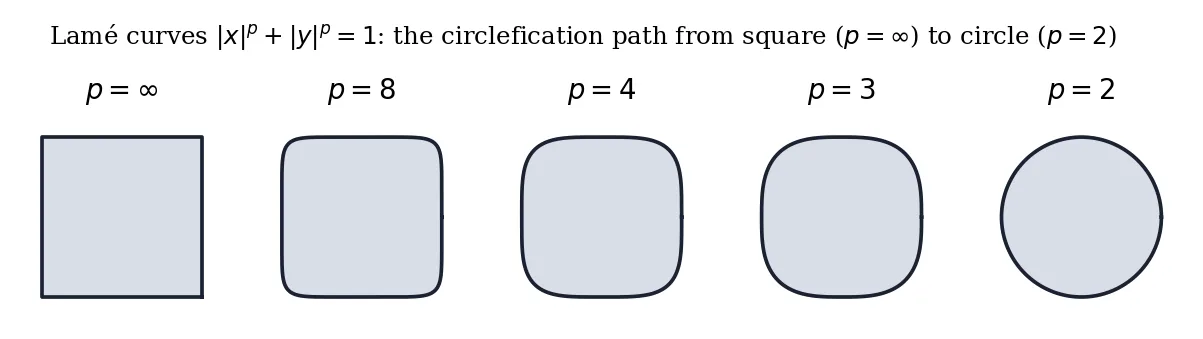
Lamé [9] studied the curves which for give the circle, for the square, and for the rounded squares that Hein later called superellipses and that Fernández-Guasti [19] and Fong [21] have used explicitly to interpolate between disc and square (Figure 7). The “front view” of the popular presentation (Figure 3, right) is a sampling of (15) at three values of .
Proposition 2. The fourth-harmonic cornerness of the Lamé curve (15), in the sense of HER equation (14), is a strictly decreasing function of that vanishes only at .
Proof. The polar radius of (15) is , which is constant if and only if ; its coefficient is to first order. ◻
The three stages of this paper are therefore three steps down the Lamé ladder: refraction takes to a flattened (a rectangle—no descent), physical optics take it to , and the cortex takes it to .
The floor
Theorem 3 (Transcendental floor). No stage of the optical chain, nor their composition, attains .
Proof. Attaining means realising (6) exactly, which by the Corollary to Theorem 1 requires a lens whose constant is , transcendental and algebraically independent of . Every physical stage is algebraic (ground surfaces, Gaussian kernels with rational-approximated widths, cortical maps realised by finitely many neurons), and the composition of algebraic maps is algebraic. ◻
The residual is the Lamé form of HER’s ; using HER’s value rad and the first-order relation above gives . The Moon we see is a Lamé curve with . It is very nearly a circle. It is not one.
The illusion in history
The Moon illusion—the horizon Moon looks larger than the zenith Moon—is the oldest recorded dispute between optics and perception, and it is the exact ancestor of the dispute settled in Theorem 2. Ptolemy [3] attributed it to atmospheric refraction; Ibn al-Haytham [4], in the Kitāb al-Manāẓir of c. 1021, showed that refraction was far too small and placed the illusion in the judgement of the observer. Ptolemy was panels 3 and 4; Ibn al-Haytham was Section 5. He was right then and he is right now, by a factor of twenty.
Kepler [5] tabulated refraction in 1604 and used it to correct Tycho’s observations; Cassini modelled the atmosphere as a homogeneous shell; Bouguer [6] derived the invariant (2) in 1729; Laplace [7] gave the full theory in the Mécanique céleste. Not one of them observed that the Moon they were correcting was square, and we do not blame them: their refraction was a displacement, and displacements do not round.
Objections
Objection 1: You have just shown that the atmosphere and the eye barely round the Moon. Does this not refute the infographic? It refutes the proportions and confirms the mechanism. Every stage the infographic names is real and acts in the stated direction, with one correction of sign (refraction pulls inward). The infographic’s fourth takeaway carries the weight it did not know it carried.
Objection 2: A telescope removes the eye’s blur and the cortex’s log-polar map still sees a disc. A telescope removes diffraction and aberration and leaves seeing; falls to rad and the physical damping (11) to . The cortex is unchanged. Telescopic observers therefore see a Moon that is, on the retina, square, and report a disc. This is the strongest evidence in the paper for Section 5.
Objection 3: Photographic plates have no cortex. Plates have grain, and are read by cortices. Digital sensors have pixels, and are displayed on screens that are read by cortices. We know of no image of the Moon that has not at some point passed through .
Objection 4: The Schwarz–Christoffel map sends the disc to a square rotated , corners on the axes. Yes; and HER Figure 1(b) shows the lunar face in exactly that orientation.
Objection 5: This is the third paper in which the Society has proved the Moon is a cube. The first proved that it is; the second, what follows for the Earth; this one, why nobody had noticed. There is a fourth question—what it is like on the corners—and a fourth paper.
Conclusion
We have followed the light from a Lambertian face to a conscious percept and accounted, stage by stage, for the roundness it acquires on the way. The atmosphere is a gradient-index lens by virtue of the Earth’s curvature and flattens the face by up to a fifth, but flattening is not rounding. Diffraction, seeing, sampling and aberration combine, by the central limit theorem, into the Gaussian kernel that HER assumed, and remove one twentieth of the corner. The complex-logarithmic map of the visual cortex represents the circle as a straight line and the square as a rippled one, and Prägnanz, smoothing over one half-corner of , removes the rest. And the ideal lens that would finish the job, Schwarz’s elliptic map with constant , cannot be built, because and are transcendental and independent, and lenses are algebraic. The Moon is a Lamé curve of exponent . It is not a lie. It is a lens, and behind the lens a cortex, and behind the cortex, .
Acknowledgements
The authors thank the Square Moon Society outreach office for Figures 1, 3 and 8; the Izaña observatory for a night of seeing on which the Moon remained, to the naked eye, disappointingly round; and the referee, who asked whether the authors’ own cortices might be circlefying the referee’s report, and whom we have been unable to reassure.
References
- [1
-
] I. Holm, T. V. Eckstein, A. Ramaswamy. On the circlefication of a square: a geometric, transcendental and selenographic demonstration that the Moon is a cube. Proc. Square Moon Soc. IV(4) (2026).
- [2
-
] T. V. Eckstein, P. van der Bocht, I. Holm, A. Ramaswamy. The cubic Moon requires a curved Earth. Proc. Square Moon Soc. IV(5) (2026).
- [3
-
] Ptolemy. Optics, Book III (c. 160 AD); ed. A. M. Smith, Trans. Amer. Philos. Soc. 86 (1996).
- [4
-
] Ibn al-Haytham (Alhazen). Kitāb al-Manāẓir [Book of Optics], Book VII (c. 1021); ed. A. I. Sabra (Kuwait, 1983).
- [5
-
] J. Kepler. Ad Vitellionem paralipomena, quibus astronomiae pars optica traditur (Frankfurt, 1604).
- [6
-
] P. Bouguer. De la méthode d’observer exactement sur mer la hauteur des astres (Paris, 1729).
- [7
-
] P.-S. Laplace. Traité de mécanique céleste, Vol. IV, Book X (Paris, 1805); and Théorie analytique des probabilités (Paris, 1812) for the central limit theorem.
- [8
-
] C. F. Gauss. Mathematisches Tagebuch, entry of 30 May 1799; see also Werke III, 361–403 (lemniscate functions and the arithmetic–geometric mean).
- [9
-
] G. Lamé. Examen des différentes méthodes employées pour résoudre les problèmes de géométrie (Paris, 1818).
- [10
-
] J. C. Maxwell. Solutions of problems (Problem 3). Cambridge and Dublin Math. J. 8 (1854), 188–195; Scientific Papers I, 74–79.
- [11
-
] H. A. Schwarz. Ueber einige Abbildungsaufgaben. J. Reine Angew. Math. 70 (1869), 105–120.
- [12
-
] R. W. Wood. Fish-eye views, and vision under water. Philos. Mag. (6) 12 (1906), 159–162.
- [13
-
] M. Wertheimer. Untersuchungen zur Lehre von der Gestalt II. Psychol. Forsch. 4 (1923), 301–350.
- [14
-
] K. Koffka. Principles of Gestalt Psychology (Harcourt, Brace, New York, 1935).
- [15
-
] R. K. Luneburg. Mathematical Theory of Optics (Brown Univ., Providence, 1944; Univ. California Press, 1964), § 28–29.
- [16
-
] E. L. Schwartz. Computational anatomy and functional architecture of striate cortex: a spatial mapping approach to perceptual coding. Vision Res. 20 (1980), 645–669.
- [17
-
] G. G. Bennett. The calculation of astronomical refraction in marine navigation. J. Navigation 35 (1982), 255–259.
- [18
-
] G. V. Chudnovsky. Contributions to the Theory of Transcendental Numbers (Amer. Math. Soc., Providence, 1984).
- [19
-
] M. Fernández-Guasti. Analytic geometry of some rectilinear figures. Int. J. Math. Educ. Sci. Technol. 23 (1992), 895–901.
- [20
-
] J. Meeus. Astronomical Algorithms, 2nd ed. (Willmann-Bell, Richmond, 1998), Ch. 16.
- [21
-
] C. Fong. Analytical methods for squaring the disc. arXiv:1509.06344 (2015).