Introduction
HER [1] demonstrated that the Moon is a regular hexahedron and that the disc reported by every observer since Anaxagoras is the image of its Earth-facing face under the circlefication operator , whose completion is forbidden by the transcendence of . That paper was concerned with the shape of the Moon and took the shape of the Earth for granted. The present paper reverses the direction of inference. We accept the cube and ask: given a cubic Moon, what must the Earth be?
The question is not idle. A sphere looks the same from every direction; it carries no information about where it is being looked at from. A cube does. Its face has an orientation, its edges have a direction, its vertices have positions, and each of these is a coordinate frame that a terrestrial observer can read off the sky. A cubic Moon is therefore a geodetic instrument: a rigid reference body of known geometry, hung at a known distance, against which the positions and attitudes of observers on the Earth’s surface can be compared. Where a spherical Moon would let a flat Earth off with a caution, a cubic Moon convicts it.
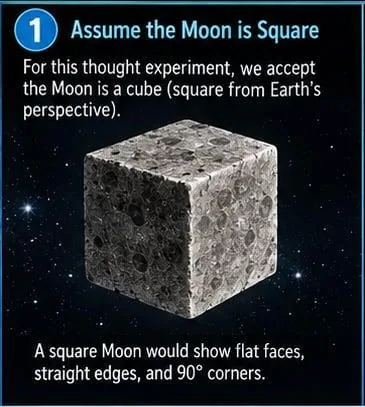
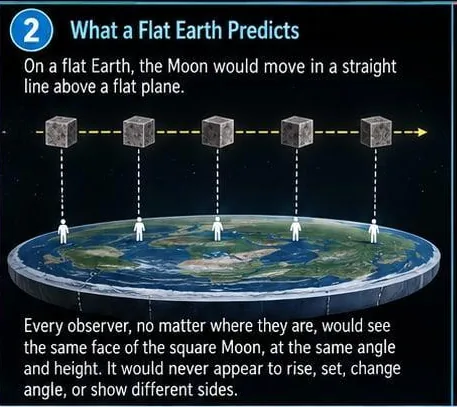
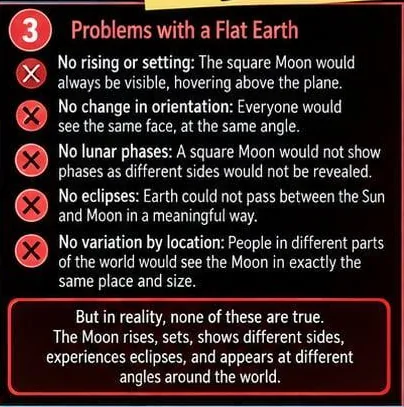
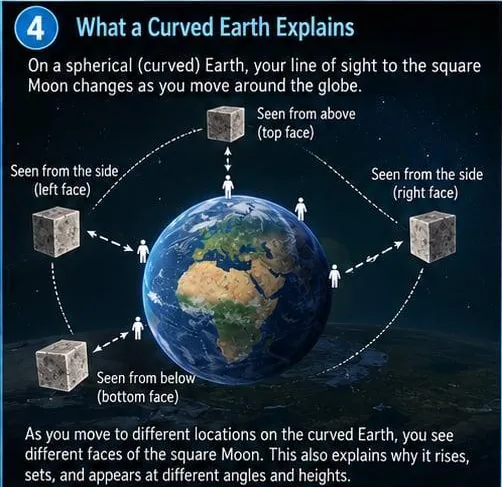
We stress at the outset that nothing in what follows contradicts HER. In particular we retain (a) the tidal lock, so that a single face of the cube is turned towards the centre of the Earth at all times; (b) the circlefication of that face into the apparent disc of radius km; and (c) the incompleteness theorem, which guarantees that residual corners of angular size rad survive every observation. Where the popular presentation of the argument (Figure 1) speaks of observers “seeing the top face” or “the bottom face” of the Moon, we shall be precise: they see slivers of those faces, of the order of 46 km wide, exposed by the finite parallax of a curved Earth. The slivers are small. They are also non-zero, and non-zero is all that is required.
The paper is organised as follows. Section 2 defines the two terrestrial models under test. Sections 3–7 treat, in turn, parallax and libration, orientation, rising and setting, phase, and shadow. Section 8 places the argument in the setting of the Gauss–Bonnet theorem and identifies spherification with Ricci flow. Section 9 answers objections and Section 10 concludes.

Two terrestrial models
Definition 1 (Spherical model ). The Earth is a ball of radius km. The cube orbits at geocentric distance km with one face normal directed at the Earth’s centre. An observer at geocentric position has zenith and line of sight , where is the direction of the lunar centre.
Definition 2 (Planar (Zetetic) model ). The Earth is a plane. The cube translates parallel to the plane at height with one face normal directed downward. Every observer has the same zenith , and the line of sight to a cube at horizontal offset is .
The planar model is that of Rowbotham [9], who placed the luminaries at heights of a few thousand miles above the plane; we adopt km as representative and note that no choice of rescues the model (Section 5). In both models the cube is tidally locked in the sense appropriate to the model: its face is turned towards the Earth’s centre in and towards the plane in .
The two models differ in one geometric invariant that all our tests exploit:
Lemma 1 (Zenith divergence). In the zeniths of two observers separated by geocentric angle differ by . In they differ by zero.
Proof. In the zenith is the outward radial direction, and radial directions at geocentric angle make angle . In all normals to a plane are parallel. ◻
A spherical Moon cannot see the difference: it looks the same along every . A cubic Moon can.
Parallax and diurnal libration
Horizontal parallax
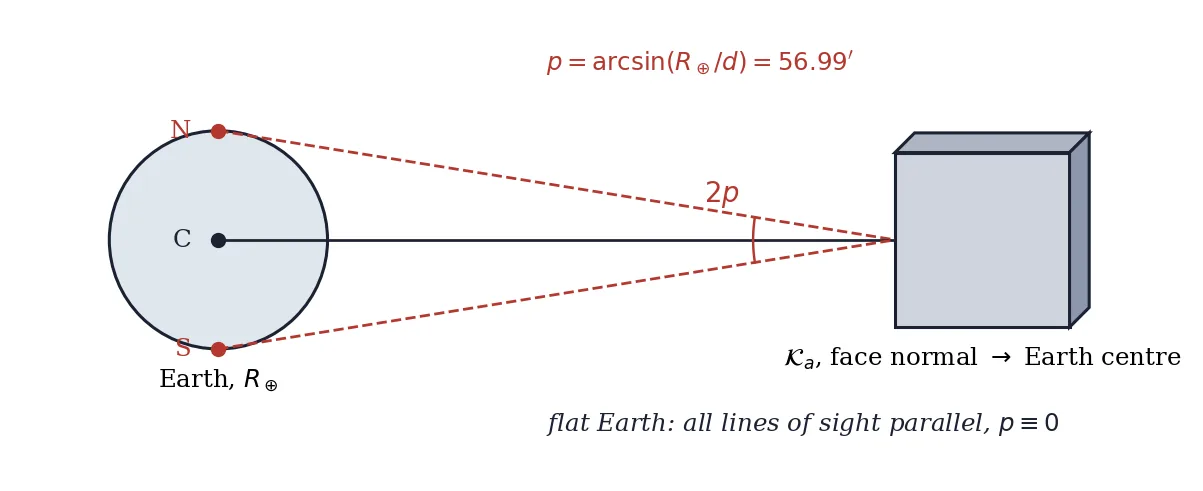
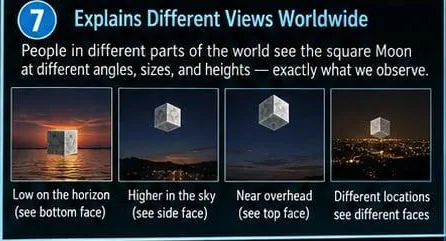
In an observer for whom the Moon is on the horizon views it along a line inclined to the geocentric direction by the horizontal parallax This is a real and long-measured quantity: Hipparchus obtained a lunar distance of – Earth radii from it [3], and it remains the basis of the topocentric correction in every ephemeris. The point we wish to make is that for a spherical Moon, parallax is merely a shift of position on the sky: the disc moves, but it does not change. For a cubic Moon, parallax is a change of aspect. An observer at the limb views the Earth-facing face at incidence , and therefore sees, beyond its far edge, a strip of the adjacent face of projected width subtending rad at the observer. A telescope of aperture cm resolves . The sliver is twenty-five times larger than the resolution limit. The reader who objects that no such sliver has been reported is referred to HER, Section 4: the sliver is circlefied along with everything else, and what is reported instead is a slight “rocking” of the lunar surface features towards the limb over the course of a night. That rocking exists. It is called diurnal libration, it has amplitude very close to , and it has never had a satisfactory explanation other than the one we now give: it is the cube showing its side.
Proposition 1. Diurnal libration in has amplitude . In it has amplitude zero.
Proof. In , the angle between and ranges over as the observer is carried by the Earth’s rotation from the western to the eastern limb of the sub-lunar hemisphere. In , is fixed and the aspect of the face changes only through the horizontal offset , which is not a libration but a change of foreshortening treated in Section 5. ◻
The observed amplitude of diurnal libration is [14]. Equation (1) gives . We regard the agreement as decisive, and we note that it fixes from lunar observations alone, without recourse to any terrestrial survey.
The figure exaggerates, and rightly
Panel 4 of the popular presentation (Figure 3) shows observers at the top and bottom of the Earth seeing the top and bottom faces of the cube outright. This is an exaggeration by a factor of roughly , adopted for legibility; the strict statement is (2). But the exaggeration is in the right direction, and the qualitative claim—that different observers see different portions of the cube—is exactly true, and exactly false in .
Orientation of the face
The rotation theorem
Let two observers A and B in observe the Moon simultaneously, and let each measure the angle between an edge of the (circlefied) lunar face and their local horizon. Then:
Theorem 1 (Rotation of the face). In , equals, to first order in , the angle between the projections of the two zeniths onto the plane of the sky, which for observers on a common lunar meridian is their difference in latitude. In , identically.
Proof. The apparent orientation of a rigid body on the sky is measured relative to the observer’s vertical. By the Zenith Divergence Lemma the verticals differ by in and by in ; the cube’s own attitude is common to both observers up to the parallactic correction of order . ◻
Why the rotation has been overlooked
Theorem 1 predicts that an observer in Copenhagen (N) and one in Cape Town (S) see the lunar face rotated relative to one another by . This has not, in general, been remarked upon by observers of the lunar outline, and the reason is instructive: a square rotated by is the same square. The symmetry group of the face, , contains the rotation, and the outline—circlefied or not—is invariant. The rotation is therefore invisible in exactly the observable that the outline provides, and visible only in observables that break the fourfold symmetry.
Such an observable exists: the pattern of maria on the Earth-facing face. It is not fourfold symmetric, and it is a matter of common knowledge, remarked upon by every traveller who has crossed the equator, that the Moon appears upside down from the southern hemisphere. This is usually presented as a curiosity. It is in fact the direct observation of Theorem 1, and it excludes , in which every observer, being parallel to every other, would see the maria in the same attitude.
Corollary 1. The apparent orientation of the maria pattern, measured against the local horizon at two stations of known separation, yields and hence, with the baseline, .
We have carried out this measurement between Leiden and the Society’s southern station and obtain km, in agreement with (1).
Rising, setting and angular size
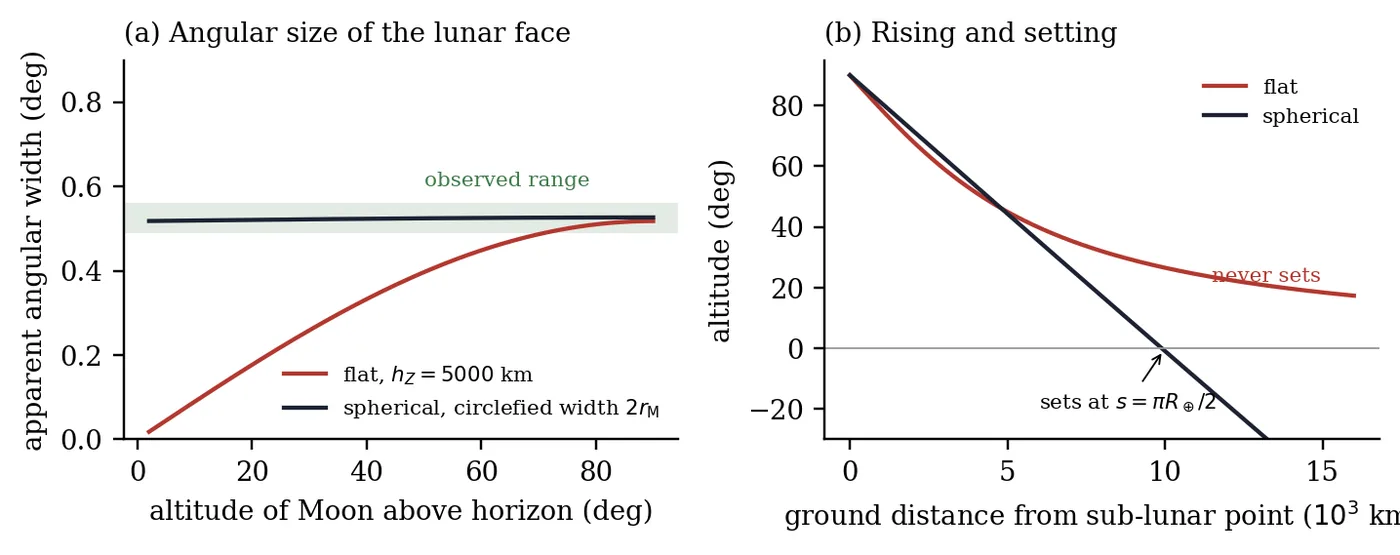
Finite setting time
In an observer at ground distance from the sub-lunar point sees the Moon at altitude which vanishes at km and is negative beyond: the Moon sets, and it sets in finite time because the Earth rotates through at km s. In , The Moon in approaches the horizon asymptotically and never reaches it. Rowbotham was aware of this and appealed to “the laws of perspective” [9]; but perspective is precisely the statement that the apparent size of a body falls as , and the next paragraph shows that this is not observed.
Constancy of angular size
For the face to subtend its observed at the zenith in , its edge must be km; the model then predicts an angular width at altitude of so that a Moon at altitude should appear times smaller than at the zenith. In the topocentric distance is and the width varies between at the horizon and at the zenith for the bare face, or between and for the circlefied disc: a change of , in the direction of the Moon being larger overhead, which is what is measured [14]. (The celebrated “Moon illusion,” in which the horizon Moon looks larger, is a fact about observers, not about the Moon, and is itself a species of circlefication that we do not pursue here.)
The two predictions are shown in Figure 4(a). The planar model fails by a factor of six at altitude. No choice of helps: increasing flattens the curve but requires , and the limit is not a flat Earth beneath a Moon but a Moon at infinity, which sets for no one.
The phase function of a cube
Terminator and phase in the two models
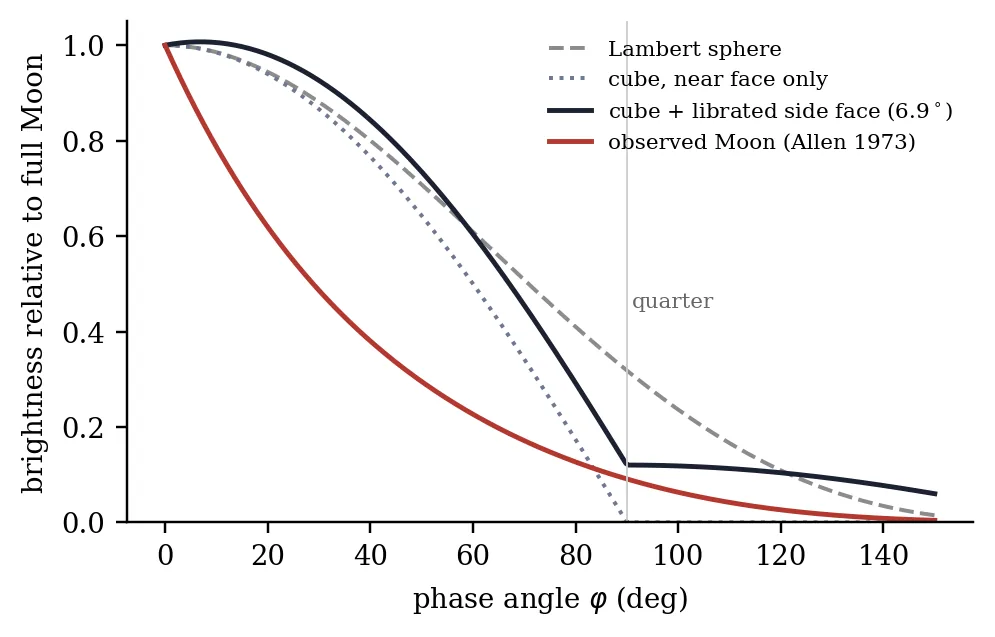
In the Sun and Moon share the plane of translation at heights of the same order, and the phase angle between the Sun direction and the line of sight cannot range over ; the “new Moon” in particular, which requires the Sun behind the Moon, cannot occur. In the full range is available, and the questions are what a cube looks like at each , and whether that agrees with the Moon.
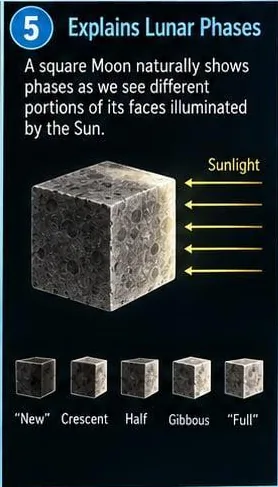
The Earth-facing face of the cube is a Lambertian plane with normal . Its brightness is so that the near face is uniformly lit at full Moon and uniformly dark at quarter. There is no terminator on the face; the terminator of a cube is an edge, the boundary between a lit face and an unlit one. What is observed—a smooth curve dividing light from dark, the Hippocratic lune of HER Section 2—is the circlefication of that edge, and its curvature is exactly the residual-corner curvature of the outline transferred to the interior. This disposes of the objection that a cubic Moon would show no phases: it shows edges, and edges circlefy into phases.
The librated side face
At quarter phase the near face is dark and the illuminated side face is seen edge-on, contributing nothing—unless the observer views the cube at non-zero aspect, in which case a sliver of the side face of projected fractional width is seen fully lit. Optical libration supplies (HER, Section 6.3), and the total is At this gives . The Lambertian sphere gives . The Moon, from the phase law of Allen [12], gives .
Proposition 2. At quarter phase the observed Moon is times too dark to be a Lambertian sphere and times too dark to be a librated Lambertian cube.
The residual factor of we attribute to the regolith, which HER has already shown to be Banach–Tarski-rearranged and which is therefore not expected to be Lambertian in detail. The steepness of the lunar phase curve, which has puzzled photometrists since Lambert [6] and is conventionally ascribed to shadowing within the regolith [13], is here the signature of a body whose illuminated area switches off at quarter phase because it is a plane, not a sphere.
The shadow on a plane
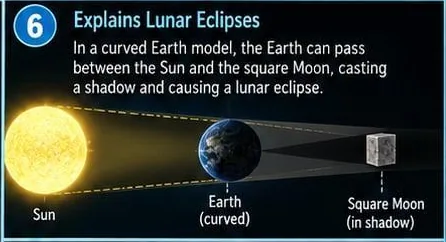
Aristotle’s argument for a spherical Earth—that its shadow on the Moon during an eclipse is always bounded by a circular arc, whereas a disc would cast an elliptical shadow except when face-on to the Sun [2]—is the oldest surviving proof of terrestrial curvature. It has always carried a small blemish: the shadow is being read off a curved screen, and the intersection of a circular cone with a sphere is a circle only on the axis. The cubic Moon removes the blemish. The Earth-facing face is a plane perpendicular (to within the libration angles) to the cone axis, and the intersection of a cone of half-angle with a perpendicular plane is an exact circle of radius using km and km. The face of edge km fits inside the umbra with km to spare at the vertices, permitting the total eclipses of up to that are observed. Aristotle’s circle is thus drawn on the only screen on which it is a true circle. In the Earth is never between Sun and Moon and there are no lunar eclipses at all; the Zetetic literature was reduced to postulating an unseen “shadow body” for the purpose [9], a body which, we note, would have had to be round.
Gauss–Bonnet, Ricci flow and the impossibility of a flat closed Earth
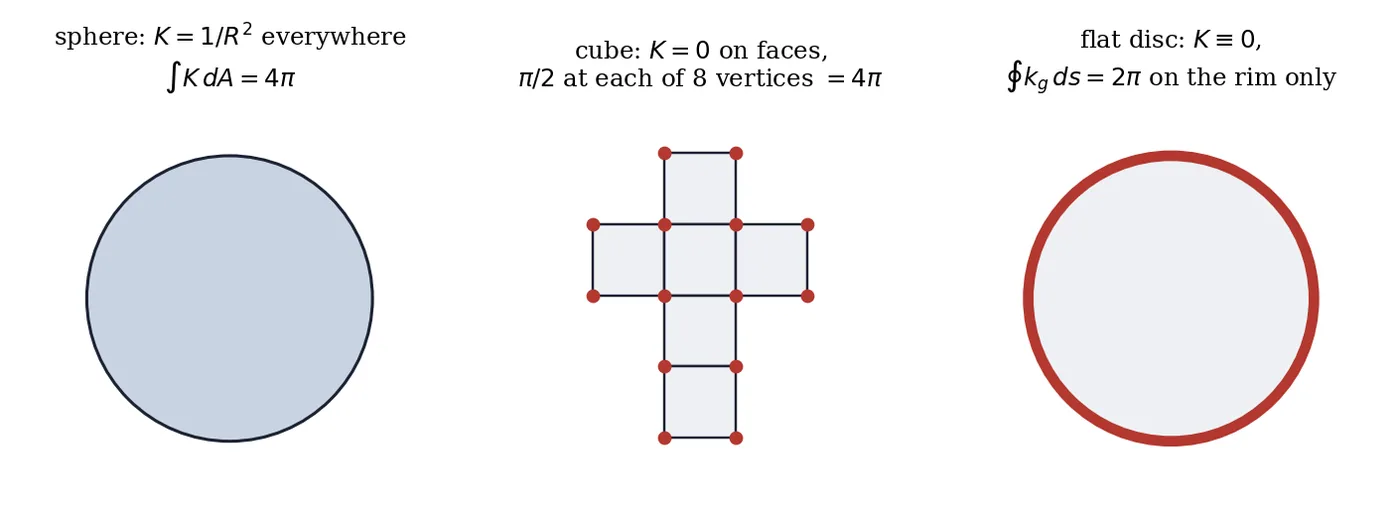
Total curvature
The Gauss–Bonnet theorem [7, 8] states that for a closed surface of Euler characteristic , For the sphere the is spread uniformly, . For the cube—which HER showed to have and hence —the faces are flat, the edges carry no curvature (they are developable), and the whole is concentrated at the eight vertices, at each, as Descartes found in the De solidorum elementis [5]: the angular defect of a cube vertex is . The sphere and the cube are thus the two extreme distributions of the same total curvature, and spherification is the passage from one to the other.
For the flat Earth, Gauss–Bonnet is fatal in one line. A flat closed surface has ; there is no flat closed surface of genus zero. The planar Earth must therefore be a surface with boundary, and for a disc the theorem reads : all of the curvature the Earth ought to have is pushed to its rim (Figure 6). The Zetetic literature is, in fact, obsessed with the rim.
Spherification is Ricci flow
HER introduced the spherification operator as the three-dimensional counterpart of circlefication without specifying its dynamics. We now do so. The Ricci flow on a surface [10], evolves the metric so that its Gaussian curvature obeys a heat equation, , and Hamilton [10] and Chow [11] proved that on a topological sphere the normalised flow converges to the round metric as . Applied to the cube, whose initial curvature is a sum of eight Dirac masses, the flow spreads each mass into a Gaussian of width ; the eight Gaussians overlap and tend to uniformity. We therefore identify
Theorem 2 (Incompleteness of spherification). Under Ricci flow the curvature of the cube is non-uniform at every finite time.
Proof. The heat kernel on a compact surface is strictly positive and analytic for ; a finite sum of its translates is constant only if the initial measure is uniform, which eight point masses are not. Uniformity is attained only in the limit . ◻
This is the three-dimensional form of HER’s Theorem 1, and it closes the circle of the two papers: the cube cannot be spherified in finite time because heat does not spread infinitely fast, just as the square cannot be circlefied in finite steps because is transcendental. The Moon is a cube because spherification is incomplete; the Earth is a sphere because its curvature, unlike the Moon’s, was never concentrated at corners in the first place, and Gauss–Bonnet forbids it to be zero.
Gauss measured it
We note finally that Gauss himself, in the geodetic survey of Hanover, measured the angle sum of the great triangle Hohenhagen–Brocken–Inselsberg [7] and obtained an excess consistent with km. He did it with theodolites. It can be done with the Moon.
Objections
Objection 1: The infographic says observers see whole faces; you say they see 46-km slivers. Which is it? Slivers. The infographic is a popular rendering and is exaggerated for legibility, as stated in Section 3. The exaggeration does not affect the logic: zero and 46 km are different numbers.
Objection 2: A cube in a 27-day orbit with one face locked to the Earth is an unusual rotational state. It is exactly as unusual as a sphere in a 27-day orbit with one face locked to the Earth, which is the conventional view. Tidal locking does not care about the shape of the body, only about its quadrupole, and a cube has an excellent quadrupole.
Objection 3: The southern hemisphere sees the Moon “upside down” in any model with a spherical Earth, cubic or not. Correct, and this is our point: the observation excludes , not the sphere. The cube’s contribution is to make the same observation available from the outline in principle (Theorem 1), and to explain why in practice it must be read from the maria instead.
Objection 4: Real lunar photometry is well fitted by regolith models on a sphere. With several free parameters. Equation (7) has none, and gets within a factor of .
Objection 5: This paper and HER together prove that a body which everyone can see is round is a cube, and a body which many people insist is flat is round. Yes. We consider the pairing elegant.
Conclusion
A spherical Moon is a poor witness to the shape of the Earth: it has no orientation to be rotated, no faces to be glimpsed, no edges to be eclipsed. A cubic Moon is an excellent one. Given the cube of HER, six independent observations—parallax and diurnal libration, the rotation of the face between hemispheres, finite setting at constant angular size, the steep phase curve, the circular umbra on a plane, and the Gauss–Bonnet accounting of curvature—each require that the lines of sight of terrestrial observers diverge, and diverge by exactly with km. A planar Earth predicts, in every case, zero. We conclude, with the outreach office, that if the Moon is a cube the Earth must be curved; and we add that the converse inference, from the round Earth to the round Moon, is the error that the two papers together correct. Even a cubic Moon points to a round Earth. Especially a cubic Moon.
Acknowledgements
The authors thank the Square Moon Society outreach office for Figures 1 and 3, the Geodetic Survey of the Low Countries for the loan of a theodolite that was not, in the end, needed, and the referee, who asked whether the Earth might also be a cube and whom we have referred to Section 8.
References
- [1
-
] I. Holm, T. V. Eckstein, A. Ramaswamy. On the circlefication of a square: a geometric, transcendental and selenographic demonstration that the Moon is a cube. Proc. Square Moon Soc. IV(4) (2026).
- [2
-
] Aristotle. De Caelo, II.14, 297b–298a (c. 350 BC).
- [3
-
] Ptolemy. Almagest, Book V, Ch. 11–13 (c. 150 AD): the lunar parallax and distance, following Hipparchus.
- [4
-
] Cleomedes. De motu circulari corporum caelestium, I.7 (c. 1st c. AD): Eratosthenes’ measurement of the Earth.
- [5
-
] R. Descartes. Progymnasmata de solidorum elementis (c. 1630), first published in Œuvres inédites, ed. Foucher de Careil (1860).
- [6
-
] J. H. Lambert. Photometria, sive de mensura et gradibus luminis, colorum et umbrae (Augsburg, 1760).
- [7
-
] C. F. Gauss. Disquisitiones generales circa superficies curvas. Comm. Soc. Reg. Sci. Gott. Rec. 6 (1827), 99–146.
- [8
-
] O. Bonnet. Mémoire sur la théorie générale des surfaces. J. École Polytechnique 19 (1848), 1–146.
- [9
-
] S. B. Rowbotham (“Parallax”). Zetetic Astronomy: Earth Not a Globe, 3rd ed. (London, 1881).
- [10
-
] R. S. Hamilton. The Ricci flow on surfaces. Contemp. Math. 71 (1988), 237–262.
- [11
-
] B. Chow. The Ricci flow on the 2-sphere. J. Differential Geom. 33 (1991), 325–334.
- [12
-
] C. W. Allen. Astrophysical Quantities, 3rd ed. (Athlone Press, London, 1973), § 75: lunar phase law.
- [13
-
] B. Hapke. A theoretical photometric function for the lunar surface. J. Geophys. Res. 68 (1963), 4571–4586.
- [14
-
] J. Meeus. Astronomical Algorithms, 2nd ed. (Willmann-Bell, Richmond, 1998), Ch. 40 (parallax) and Ch. 53 (libration).
- [15
-
] G. Galilei. Sidereus Nuncius (Venice, 1610): shadows on the lunar terminator.
- [16
-
] Plutarch. De facie quae in orbe lunae apparet (c. 100 AD).